
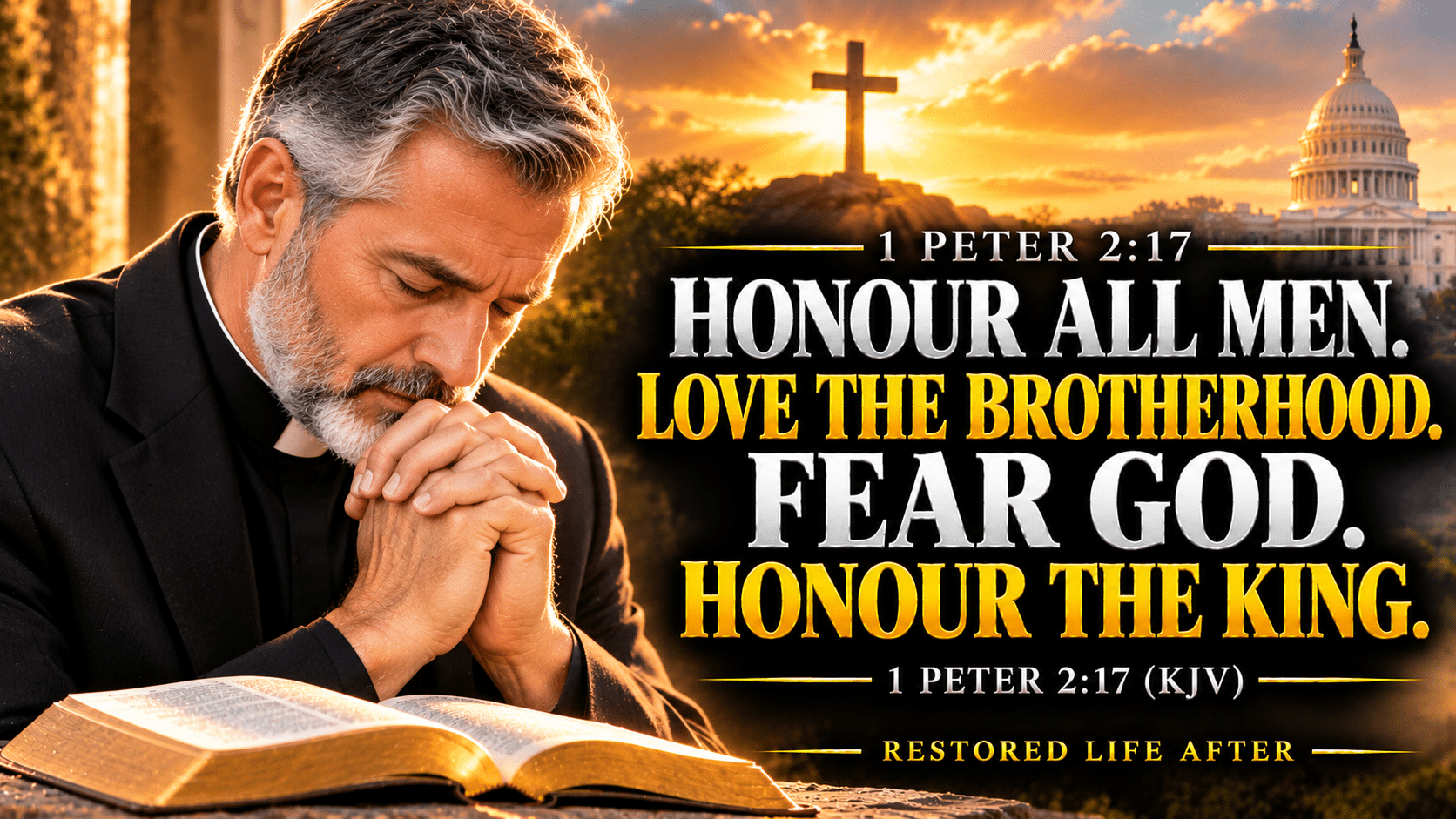
Question: What does 1 Peter 2:17 really mean? Are Christians commanded to respect everyone, even those who disrespect them? And what does it mean to fear God and honor those in authority?
Answer:
We live in a world where respect is demanded but rarely demonstrated. People want to be honored without being honorable. They want kindness without showing kindness. They demand loyalty while practicing betrayal, and they expect others to treat them with dignity while showing little concern for anyone else’s. But God’s Word teaches something far greater than the world’s understanding of respect. Respect is not simply about how others treat you. It is about the character you demonstrate before God, regardless of how others choose to behave.
The apostle Peter gives us four powerful commands in one short verse. Each carries a responsibility, and together they reveal how Christians are called to live in a world that does not always share their faith, values, or convictions.
1 Peter 2:17 (KJV):
“Honour all men. Love the brotherhood. Fear God. Honour the king.”
Four commands. Four responsibilities. And a message that reaches into every relationship, every disagreement, and every decision we make.
1. HONOUR ALL MEN — RESPECT IS NOT RESERVED FOR PEOPLE YOU LIKE
Peter begins with the words, “Honour all men.”
Notice that he does not say to honor only those who agree with you, those who treat you kindly, those who share your beliefs, or those who have something to offer you.
He says all.
Every human being has value because mankind was created in the image of God.
Genesis 1:27 (KJV):
“So God created man in his own image, in the image of God created he him; male and female created he them.”
That means the poor deserve dignity just as much as the wealthy. The stranger deserves kindness just as much as the friend. The person who disagrees with you deserves to be treated as a human being, even when you cannot agree with their actions.
But understand something important: Honoring a person does not mean approving of everything that person does.
You can respect someone’s humanity while rejecting their dishonesty. You can speak kindly to someone while refusing to participate in their wrongdoing. You can forgive a person without allowing them to continue abusing your trust.
God never commanded us to abandon wisdom in order to demonstrate kindness.
Romans 12:18 (KJV):
“If it be possible, as much as lieth in you, live peaceably with all men.”
Notice the words “if it be possible.” Peace requires more than one person’s willingness. You are responsible for your conduct, but you cannot control another person’s character.
Show respect because of who you are in Christ, not because everyone around you has earned your approval.
2. LOVE THE BROTHERHOOD — GOD’S FAMILY MUST BE MORE THAN WORDS
Peter’s second command is “Love the brotherhood.”
This refers to the special love Christians are to demonstrate toward their brothers and sisters in Christ.
The church is not merely a building where people gather. It is a spiritual family of people who belong to Christ.
And family is supposed to care for family.
Yet how often do we see jealousy, gossip, bitterness, pride, and division among people who claim to follow the same Lord?
How can we speak of loving God while deliberately mistreating those who belong to Him?
1 John 4:20 (KJV):
“If a man say, I love God, and hateth his brother, he is a liar: for he that loveth not his brother whom he hath seen, how can he love God whom he hath not seen?”
Those are strong words.
Christian love is not merely a smile on Sunday morning. It is being there when someone is hurting. It is helping the struggling, encouraging the discouraged, correcting with gentleness, and refusing to destroy another person’s reputation through gossip.
It is also being willing to forgive.
John 13:35 (KJV):
“By this shall all men know that ye are my disciples, if ye have love one to another.”
Jesus did not say the world would recognize His disciples by their popularity, wealth, buildings, or impressive speeches.
He said they would be recognized by their love.
If the world cannot see Christ in the way we treat one another, we need to examine what our actions are saying about our faith.
3. FEAR GOD — THE MOST IMPORTANT COMMAND IN THE VERSE
Now we come to the words that give the entire verse its proper foundation.
“Fear God.”
This is not a command to live in constant terror, as though God were cruel or unreasonable. It is a command to approach Him with reverence, awe, humility, and an understanding of His holiness and authority.
God is not our equal.
He is our Creator.
He is holy, righteous, and just. His Word is truth, and every human being is accountable to Him.
Ecclesiastes 12:13–14 (KJV):
“Let us hear the conclusion of the whole matter: Fear God, and keep his commandments: for this is the whole duty of man. For God shall bring every work into judgment, with every secret thing, whether it be good, or whether it be evil.”
Think about that.
Every word spoken in anger. Every dishonest decision. Every secret act of cruelty. Every opportunity to do good that we deliberately ignored.
God sees what the world never sees.
And this is why fearing God should influence how we treat others.
A person who truly fears God understands that character is not something we put on for an audience. It is something we carry even when nobody else is watching.
You cannot honor God with your lips while knowingly dishonoring Him through your actions.
You cannot claim to fear God while living in deliberate rebellion against His Word.
And you cannot place the approval of people above obedience to your Creator.
Proverbs 9:10 (KJV):
“The fear of the LORD is the beginning of wisdom: and the knowledge of the holy is understanding.”
When we fear God properly, we begin to understand our place in this world.
We become slower to judge others, quicker to examine ourselves, and more determined to live faithfully.
Fear God above every human opinion, because people can judge your appearance, but God knows your heart.
4. HONOUR THE KING — RESPECT AUTHORITY WITHOUT WORSHIPPING IT
Peter ends with the command, “Honour the king.”
When these words were written, Christians lived under Roman authority. They were not living in a world where government leaders necessarily shared their beliefs or protected their interests.
Yet Peter still commanded them to show honor.
Why?
Because Christians are called to conduct themselves with dignity and respect toward governing authorities.
Romans 13:1 (KJV):
“Let every soul be subject unto the higher powers. For there is no power but of God: the powers that be are ordained of God.”
This does not mean every government decision is righteous or that every ruler is personally approved by God.
And it certainly does not mean Christians must obey human authority when it directly contradicts God’s commands.
When the apostles were ordered to stop preaching Jesus Christ, they answered in Acts 5:29 (KJV):
“We ought to obey God rather than men.”
There is the proper balance.
Honor earthly authority, but never place earthly authority above Almighty God.
A Christian can disagree with a political leader without becoming hateful. A Christian can oppose an unjust law without abandoning self-control. A Christian can stand firmly for truth without allowing bitterness to destroy their character.
The world may encourage us to insult, ridicule, and hate everyone who disagrees with us.
But followers of Christ are called to something higher.
Respect does not require agreement.
And disagreement does not justify cruelty.
DOES HONORING EVERYONE MEAN ALLOWING YOURSELF TO BE MISTREATED?
Absolutely not.
There is a dangerous misunderstanding that kindness means accepting abuse, that forgiveness means removing every boundary, and that humility means allowing people to walk over you.
Scripture does not teach that.
Jesus demonstrated extraordinary love and humility, yet He also confronted hypocrisy, exposed wrongdoing, and refused to compromise the truth.
Ephesians 4:15 (KJV) calls Christians to speak “the truth in love.”
Both matter.
Truth without love can become cruelty.
Love without truth can become compromise.
You can be gentle without being weak. You can be forgiving without being foolish. You can respect someone while recognizing that maintaining distance may be necessary.
Respect others, but never confuse respect with surrendering your conscience, your safety, or your obedience to God.
THE DANGER OF DEMANDING RESPECT WHILE LIVING WITHOUT CHARACTER
One of the greatest problems in our world is that people have confused respect with fear.
They believe that if others are intimidated by them, they have earned respect.
But fear and respect are not the same thing.
A person may fear your anger while having no admiration for your character.
A person may obey your threats while knowing you cannot be trusted.
And a person may praise you publicly while privately recognizing your dishonesty.
True honor is not built through intimidation.
It is demonstrated through integrity, humility, honesty, faithfulness, and self-control.
Proverbs 22:1 (KJV):
“A good name is rather to be chosen than great riches, and loving favour rather than silver and gold.”
A good name is not built overnight.
It is built through years of choices.
Through promises kept.
Through wrongs acknowledged.
Through temptation resisted.
Through doing what is right when doing what is wrong would be easier.
And sometimes it is demonstrated most clearly in how you respond when someone treats you unfairly.
Never allow another person’s lack of character to become an excuse for abandoning your own.
THE FINAL ANSWER: LIVE WITH HONOR BECAUSE YOU BELONG TO GOD
First Peter 2:17 is more than a lesson about manners.
It is a blueprint for Christian conduct.
Honor all people because they have value before God.
Love the brotherhood because Christians are called to care for one another.
Fear God because He alone possesses ultimate authority over our lives.
Honor governing authorities while remembering that obedience to God always comes first.
And through it all, never forget that your actions reveal what your words may attempt to conceal.
You can carry a Bible and still have a hateful heart.
You can attend worship and still mistreat your family.
You can speak beautifully about love while destroying others with your tongue.
But God sees beyond the appearance.
He knows the truth about who we are.
So examine yourself before demanding that others change. Correct your own behavior before condemning someone else’s. Be the person who keeps their word, tells the truth, shows compassion, and refuses to surrender their character when life becomes difficult.
Give respect without becoming a doormat. Show kindness without compromising truth. Stand firm without becoming arrogant. Love others without abandoning wisdom.
And above everything else, fear God.
Because when your life is grounded in reverence for Him, you begin to understand that respect is not about making the world bow before you.
It is about living in a way that honors the One before whom every knee will someday bow.
“Honour all men. Love the brotherhood. Fear God. Honour the king.” — 1 Peter 2:17 (KJV)
RESTORED LIFE AFTER