
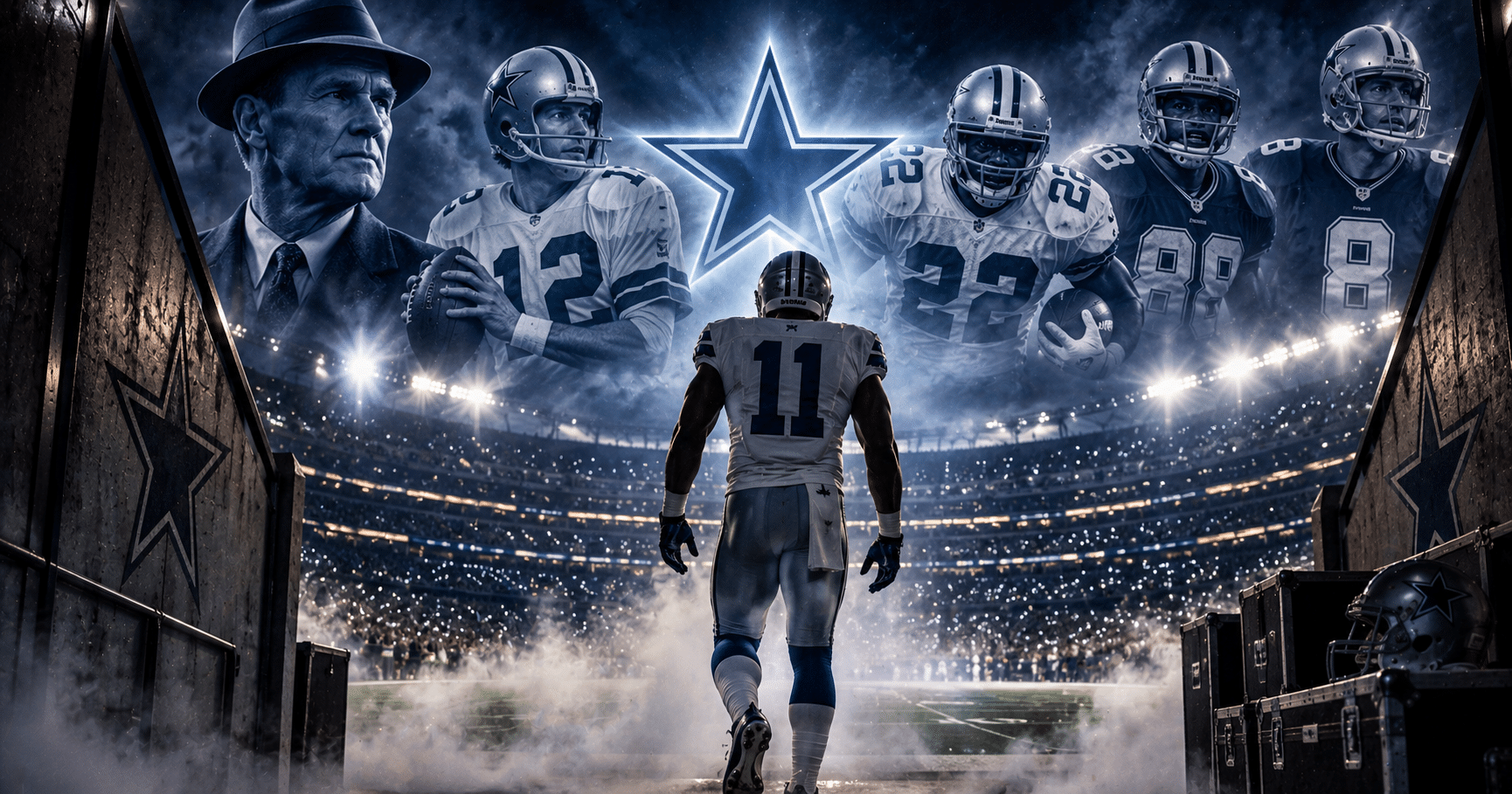
From 0–11–1 to America’s Team
There are football teams.
And then there are the Dallas Cowboys.
The blue star.
The silver helmets.
Thanksgiving Day.
Tom Landry standing on the sideline in his fedora.
Roger Staubach scrambling with the game on the line.
Tony Dorsett exploding through a hole.
The Doomsday Defense.
Troy Aikman.
Emmitt Smith.
Michael Irvin.
Jimmy Johnson screaming from the sideline.
And eventually an entire generation that simply called them:
America’s Team.
But the Dallas Cowboys didn’t begin as America’s Team.
They began as one of the worst football teams in America.
1960 — THE BEGINNING
The NFL awarded Dallas an expansion franchise in January 1960.
Professional football in Dallas wasn’t guaranteed to work. An earlier Dallas NFL franchise had failed badly in 1952, and college football already ruled Texas.
But businessman Clint Murchison Jr. believed Dallas could support an NFL team.
He surrounded himself with three men who would help build one of the most recognizable organizations in sports:
Tex Schramm.
Gil Brandt.
Tom Landry.
Landry became the first head coach.
And his first season was brutal.
The Cowboys finished:
0 wins.
11 losses.
1 tie.
They didn’t win a single game.
And things didn’t immediately get much better.
Dallas suffered losing seasons through its first five years.
Imagine today’s sports world giving a coach that much time.
But the Cowboys believed in Landry.
And eventually patience became one of the greatest investments in NFL history.
TOM LANDRY BUILDS A MACHINE
Landry wasn’t a screaming, emotional coach.
He looked more like an executive standing on the sideline.
Suit.
Tie.
Fedora.
Stone face.
But underneath that calm exterior was one of football’s great strategic minds.
Landry helped revolutionize defensive football, developed the famous Flex Defense, used sophisticated offensive motion and treated football almost like a giant chess match.
Then the Cowboys started winning.
In 1966 Dallas went 10-3-1 and reached the NFL Championship Game.
That began something extraordinary.
From 1966 through 1985, the Cowboys produced 20 consecutive winning seasons—an NFL record that still stands.
The franchise that couldn’t win a game suddenly couldn’t stop winning.
But there was heartbreak before there was glory.
Dallas lost championship games to Vince Lombardi’s Green Bay Packers in consecutive seasons, including the legendary Ice Bowl in 1967.
Then they reached Super Bowl V.
And lost again.
The Cowboys were becoming known as a team that could get close—but couldn’t finish.
Until Roger Staubach helped change everything.
CAPTAIN AMERICA
Roger Staubach wasn’t a typical NFL superstar.
He had won the Heisman Trophy at Navy, then fulfilled his military commitment before beginning his NFL career.
By the time he became Dallas’ starting quarterback, he was already approaching 30.
But Staubach brought something Dallas desperately needed.
Belief.
Leadership.
And an almost frightening refusal to quit.
In the 1971 season, Dallas finally broke through.
The Cowboys defeated the Miami Dolphins 24-3 in Super Bowl VI.
The franchise that started 0-11-1 was now champion of professional football.
And the Cowboys were only beginning.
Players such as Bob Lilly, Mel Renfro, Drew Pearson, Randy White, Tony Dorsett and Too Tall Jones became part of the mythology.
The defense earned a name:
Doomsday.
Dallas returned to Super Bowls repeatedly and won another championship in Super Bowl XII.
And somewhere along the way, something bigger happened.
“AMERICA’S TEAM”
The Cowboys became television.
Their games were everywhere.
Their cheerleaders became cultural icons.
Their Thanksgiving games became tradition.
The star became recognizable even to people who didn’t watch football.
During a 1978 highlight film, NFL Films famously referred to Dallas as “America’s Team.”
The name stuck.
People either loved the Cowboys…
or absolutely hated them.
And strangely, both helped make them bigger.
Because indifference doesn’t create legends.
THEN THE MACHINE STARTED BREAKING
Nothing lasts forever.
By the middle of the 1980s, the Cowboys were aging.
The winning slowed.
The organization that had seemed permanent suddenly looked vulnerable.
Dallas finished 3-13 in 1988.
Then everything changed.
In 1989, Arkansas businessman Jerry Jones purchased the Dallas Cowboys.
And almost immediately he made one of the most controversial decisions in NFL history.
He fired Tom Landry.
Landry had coached every season the Dallas Cowboys had ever played.
Twenty-nine years.
Two Super Bowl championships.
Five Super Bowl appearances.
Twenty consecutive winning seasons.
And suddenly he was gone.
For many Cowboys fans, it felt almost sacrilegious.
Jerry Jones replaced him with his former college teammate and University of Miami coach:
Jimmy Johnson.
Then Dallas went 1-15.
It looked like a disaster.
But underneath the losses, something was being built.
THE TRADE THAT CHANGED EVERYTHING
Dallas possessed one enormous asset:
Running back Herschel Walker.
In October 1989, the Cowboys traded Walker to Minnesota in a massive deal that ultimately provided Dallas with the ammunition to acquire numerous players and draft picks.
Those assets helped construct a monster.
Troy Aikman.
Emmitt Smith.
Michael Irvin.
Darren Woodson.
Russell Maryland.
And an offensive line that became one of the most dominant units football had seen.
Jimmy Johnson created a young, fast, aggressive football team.
And almost overnight, the Cowboys went from embarrassment to terrifying.
HOW ’BOUT THEM COWBOYS!
In January 1993, Dallas faced the San Francisco 49ers in the NFC Championship Game.
The 49ers represented the established power.
The Cowboys represented the future.
Dallas won.
In the locker room afterward, Jimmy Johnson delivered the words that would become part of Cowboys history:
“How ’bout them Cowboys!”
Then Dallas destroyed Buffalo 52-17 in Super Bowl XXVII.
The Cowboys were champions again.
The following season they beat Buffalo again in Super Bowl XXVIII.
Back-to-back championships.
Aikman was the calm leader.
Michael Irvin brought the fire.
Emmitt Smith became the heartbeat.
And the offensive line punished people.
The Cowboys weren’t simply winning.
They had become the NFL’s dominant force.
THEN SUCCESS CREATED ITS OWN PROBLEM
Jerry Jones and Jimmy Johnson were both strong personalities.
Both wanted credit.
Their relationship deteriorated.
And after winning consecutive Super Bowls, Jimmy Johnson left the Cowboys.
It remains one of the great what-if questions in football history.
How many championships could that team have won if Jerry and Jimmy had stayed together?
We’ll never know.
Barry Switzer replaced Johnson.
And Dallas still had one more championship waiting.
During the 1995 season, the Cowboys returned to the Super Bowl and defeated the Pittsburgh Steelers 27-17 in Super Bowl XXX.
Three championships in four seasons.
Five championships in franchise history.
The Dallas Cowboys had reached the mountain again.
THEN CAME THE WAIT
And this is where the story becomes complicated.
Because the Cowboys never stopped being famous.
They never stopped making headlines.
They never stopped being one of football’s biggest brands.
Jerry Jones built an enormous stadium.
Stars continued wearing the uniform.
There were great seasons, great players and division championships.
But the Super Bowl never returned.
Since that championship following the 1995 season, generations of Cowboys fans have watched the same cycle.
Hope.
Talent.
Big expectations.
A promising season.
Then heartbreak.
And yet every September, Cowboys fans believe again.
Maybe that’s part of what makes the franchise what it is.
MORE THAN FOOTBALL
The Dallas Cowboys have produced some of the greatest names the game has known.
Tom Landry.
Roger Staubach.
Bob Lilly.
Tony Dorsett.
Randy White.
Drew Pearson.
Troy Aikman.
Emmitt Smith.
Michael Irvin.
Larry Allen.
Deion Sanders.
Jason Witten.
Different generations.
Same star.
And maybe that’s the real story of the Dallas Cowboys.
They didn’t begin on top.
They began 0-11-1.
They endured years of losing before becoming champions.
They became dominant.
They fell.
They rebuilt.
They became dominant again.
And then they discovered something every dynasty eventually discovers:
Nothing stays on top forever.
But greatness leaves fingerprints.
The Cowboys changed how professional football was marketed.
They helped turn Thanksgiving football into an American tradition.
They created heroes, villains, heartbreak and memories that fathers eventually handed down to their children.
Some people see that blue star and think about Staubach.
Others see Aikman.
Others see Emmitt.
And younger fans see entirely different names.
But they’re all looking at the same star.
That’s what tradition does.
Players leave.
Coaches leave.
Stadiums disappear.
Championship banners grow old.
But something survives.
The story.
The Dallas Cowboys started with nothing.
They lost every game but one during their first season.
Then they built one of the most recognizable franchises in the history of sports.
Love them or hate them, nearly everyone knows them.
And more than six decades after that miserable first season, millions of people still put on the silver and blue believing the same thing Cowboys fans have believed for generations:
Maybe this is our year.
Because championships create trophies.
But hope creates fans.
And that star has carried both for generations.
— Restored Life After