
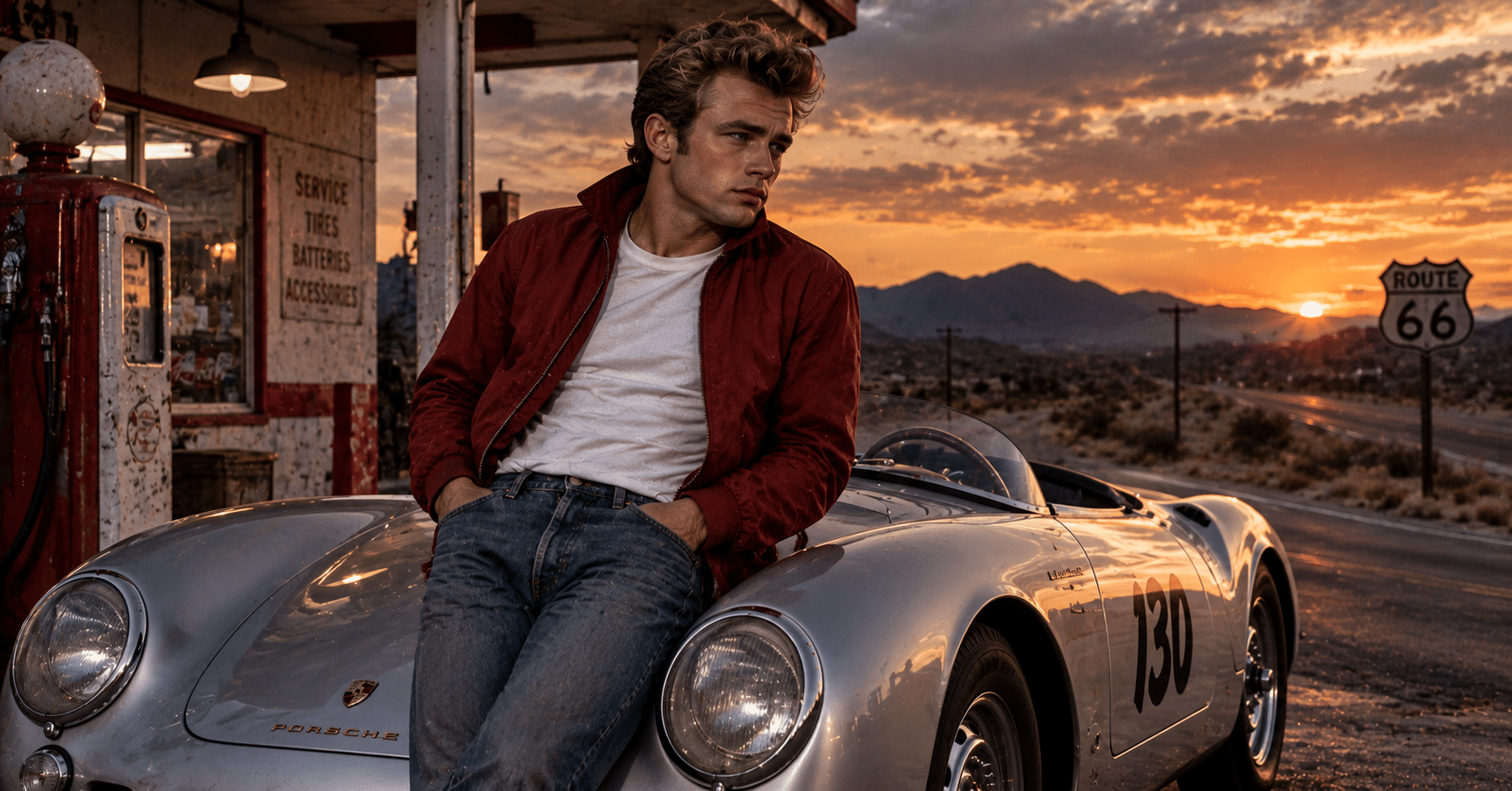
Before James Dean, Hollywood had leading men.
Handsome men. Tough men. Men who walked into a room looking like they already knew exactly who they were.
Then James Dean showed up looking like he wasn’t sure he belonged in the room at all.
And somehow that became cooler than everything that came before it.
The cigarette. The messy hair. The white T-shirt. The jeans. The leather jacket. The slouched shoulders. The distant stare. The sports cars.
But Dean’s real power wasn’t his clothes.
It was the attitude underneath them.
He made being misunderstood look dangerous.
He made vulnerability look masculine.
He made rebellion look cool.
And he helped create an image young men would imitate for generations.
James Byron Dean was born February 8, 1931, in Marion, Indiana. When he was young, his family moved to California, but tragedy entered his life early. His mother, Mildred, died of cancer when James was only nine.
After her death, Dean was sent back to Indiana to live with relatives on a farm.
Imagine that transition.
A boy loses his mother and then loses the everyday life he knew with his father.
That loneliness never seemed completely separate from the man he became.
Dean eventually returned to California, studied acting and headed for New York, where he pursued the craft seriously. He studied at the prestigious Actors Studio and absorbed the emotionally intense style of acting associated with performers such as Marlon Brando.
Dean wasn’t interested in simply looking good for the camera.
He wanted you to feel something.
Hollywood eventually noticed.
Then came East of Eden in 1955.
Dean played Cal Trask, a troubled young man desperately searching for his father’s love and approval.
Watch the performance today and you can understand why audiences responded.
Cal wasn’t the traditional movie hero.
He was angry.
Sensitive.
Jealous.
Lost.
Desperate to be loved.
James Dean made damaged young men feel seen.
Then came the movie that permanently attached one word to his name:
Rebel.
REBEL WITHOUT A CAUSE
In Rebel Without a Cause, Dean played Jim Stark, a teenager surrounded by adults who didn’t seem to understand him and young people who didn’t understand themselves.
The red jacket became iconic.
So did Dean.
But underneath the fights, cars and rebellion was something much sadder.
Jim Stark wasn’t really looking for trouble.
He was looking for somewhere to belong.
That distinction helped make Dean different.
His characters weren’t rebels because they had nothing inside them.
They rebelled because they had too much inside them and nowhere to put it.
Young audiences understood that.
Suddenly James Dean wasn’t merely an actor.
He was becoming a symbol.
Then came Giant, alongside Elizabeth Taylor and Rock Hudson. Dean played Jett Rink, and once again audiences saw something unusual—a performer who could appear arrogant, wounded, ambitious and lonely almost simultaneously.
Three major films.
That was essentially the entire legend.
East of Eden.
Rebel Without a Cause.
Giant.
And yet James Dean became one of the most recognizable actors who ever lived.
THEN ELVIS WAS WATCHING
Among the young men fascinated by Dean was another future icon:
Elvis Presley.
Elvis reportedly admired James Dean intensely and studied his performances. He wanted more than musical fame—he wanted to become a serious dramatic actor.
Dean represented something Elvis understood.
A young man could be beautiful without being polished.
Masculine without pretending he felt nothing.
Dangerous while still carrying vulnerability underneath.
Elvis had his own extraordinary identity and musical revolution underway, but Dean represented the kind of dramatic credibility Elvis wanted from Hollywood.
And Elvis wasn’t alone.
Dean’s influence stretched far beyond one entertainer.
His image became part of the vocabulary of rock and roll.
Musicians, actors, photographers and fashion designers repeatedly returned to the same blueprint:
young, handsome, wounded, detached and rebellious.
Bob Dylan referenced Dean.
John Lennon admired the rebellious image Dean represented.
Later generations of actors and musicians continued borrowing pieces of the look—the white shirt, denim, leather, cigarette, tousled hair and expression that seemed to say:
I don’t need your approval.
Dean didn’t invent rebellion.
Marlon Brando had already shattered conventions before him.
But Dean gave youthful alienation a face that became almost impossible to forget.
He became the patron saint of the misunderstood kid.
THE PORSCHE
Dean also loved speed.
Motorcycles.
Sports cars.
Racing.
Eventually he purchased a silver Porsche 550 Spyder that became known as “Little Bastard.”
On September 30, 1955, Dean was driving the Porsche toward a racing event in California.
Near Cholame, California, another vehicle turned across his path.
The Porsche crashed.
James Dean suffered catastrophic injuries.
He was pronounced dead shortly afterward.
He was 24 years old.
Think about that.
Twenty-four.
Rebel Without a Cause had not even been released yet.
Neither had Giant.
James Dean died before the world fully understood what James Dean was about to become.
Then something extraordinary happened.
Death didn’t end the image.
It froze it.
Dean would never become middle-aged.
Never lose his hair.
Never make a terrible movie at 50.
Never appear in commercials trading on his younger fame.
Never explain himself in endless interviews.
Never grow old enough for the world to watch the rebel become ordinary.
James Dean remained forever 24 years old.
And that may be one reason the legend became bigger than the man.
THE ORIGINAL REBEL
After Dean died, millions of young people discovered him.
Posters covered bedroom walls.
His photographs became fashion references.
The red jacket became mythology.
His face appeared on shirts decades after his death.
New generations who weren’t even alive when he died somehow recognized him instantly.
Because James Dean came to represent something larger than James Dean.
Youth before responsibility.
Rebellion before compromise.
Possibility before age closes doors.
He became the young man who never surrendered because he never lived long enough to have to.
But there is something darker underneath that legend.
We love people who remain young forever in photographs.
We call them icons.
Legends.
Immortal.
But James Dean wasn’t immortal.
He was a 24-year-old man whose life ended on a California highway.
There should have been more movies.
More mistakes.
More relationships.
More chances.
More years.
Maybe he would have become one of America’s greatest actors.
Maybe he would have disappeared.
Maybe he would have found peace.
We’ll never know.
That’s the terrible price hidden inside the mythology of dying young.
The world received an eternal rebel.
But James Dean lost the opportunity to become an old man.
Nearly three quarters of a century later, you can still see pieces of him everywhere.
In the musician leaning against a wall refusing to smile for the camera.
In the actor playing the wounded outsider.
In the black leather jacket.
In the white T-shirt.
In the messy hair.
In every photograph trying to capture that effortless expression of someone who couldn’t care less whether you approved.
Others came before him.
Thousands came afterward.
But very few became what James Dean became.
He didn’t simply play the rebel.
He became the image of one.
Three major films.
Twenty-four years of life.
And an influence that refused to die with him.
James Dean never got the chance to grow old.
So the rebel stayed young forever.
— Restored Life After