
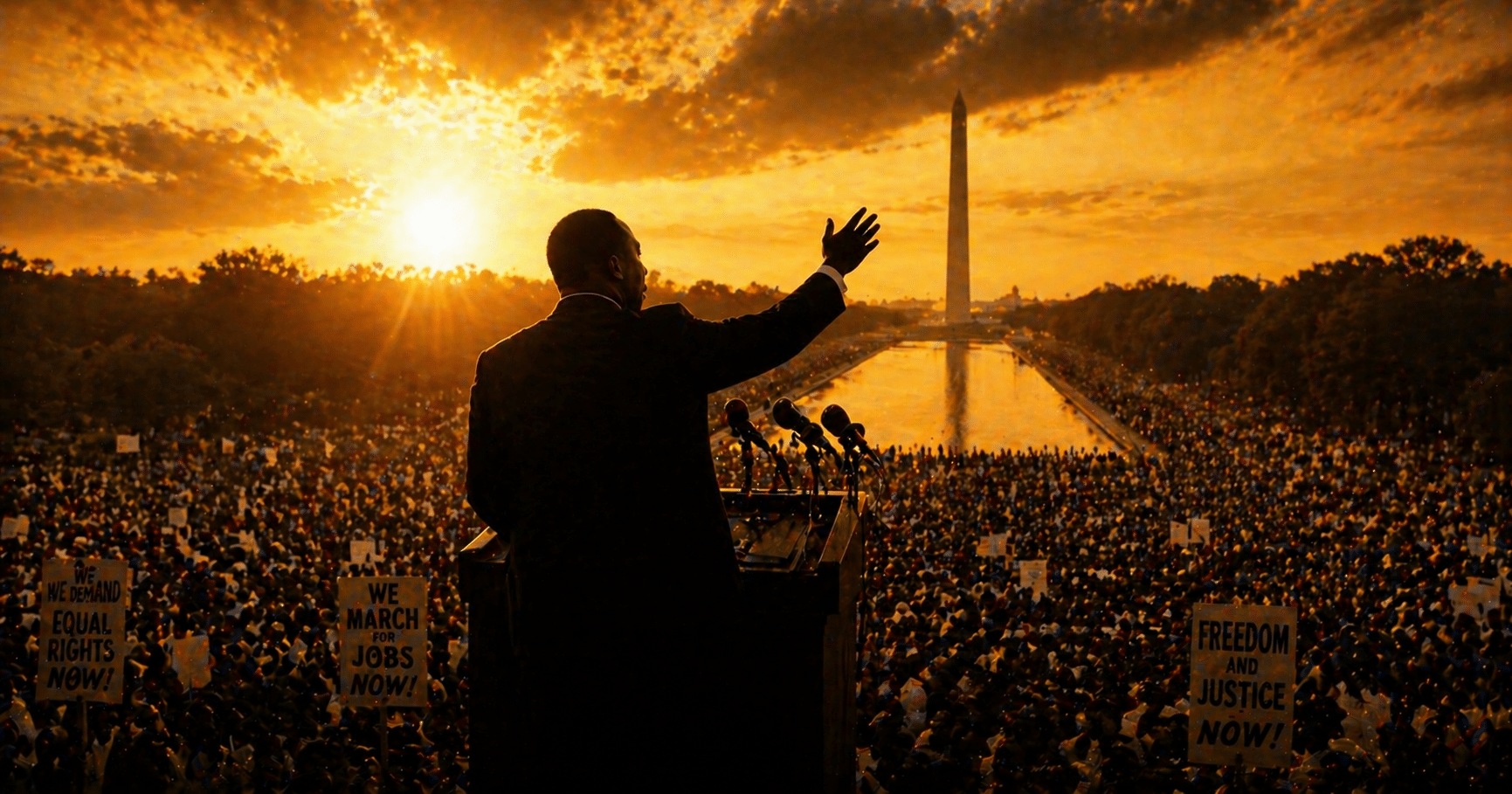
Before the speeches echoed across a nation… before the marches filled streets… before history would carve his name into the soul of America—there was a young boy growing up in a world divided by color, carrying questions no child should have to carry.
His name was Martin.
Born in 1929 in Atlanta, Georgia, into a family rooted deeply in faith, Martin Luther King Jr. was not raised in silence. His father, Martin Luther King Sr., was a strong preacher, a man who did not bow easily to injustice. His mother, Alberta Williams King, filled their home with music, grace, and dignity. The church was not just a place they went—it was the foundation of who they were.
But outside those walls…
the world was different.
Young Martin experienced racism early.
One of the lesser-known moments that shaped him deeply came when he was just a child—two white boys he had played with suddenly were no longer allowed to play with him. Their parents forbade it. Imagine that moment… confusion turning into realization. Friendship replaced by separation.
That’s when the truth begins to settle in.
That something about you… something you did not choose… would cause the world to treat you differently.
But instead of letting that bitterness grow into hatred, something else began to form in Martin.
Questions.
Conviction.
And a calling.
He was brilliant.
By the age of 15, he entered college. He later studied at Morehouse College, where he was mentored by leaders who taught him that faith was not just something you believed…
it was something you lived.
He continued his studies, eventually earning a doctorate, deeply influenced by the teachings of Jesus Christ and the philosophy of nonviolent resistance taught by Mahatma Gandhi.
But here’s what many don’t know:
Martin Luther King Jr. struggled.
He wrestled with fear.
There were nights he doubted.
Moments where the weight of what he was stepping into felt overwhelming.
He wasn’t born fearless.
He chose courage.
That courage would be tested in Montgomery, Alabama.
When Rosa Parks refused to give up her seat on a bus, it ignited something bigger than anyone expected. A boycott began. And Martin Luther King Jr., still a young pastor at Dexter Avenue Baptist Church, was chosen to lead it.
He didn’t seek the spotlight.
It found him.
The boycott lasted over a year.
Threats came.
His home was bombed.
His family was in danger.
He was arrested.
Imagine carrying that kind of pressure—not just for yourself, but for your wife, your children, your community.
There was a night—another moment many overlook—when King sat alone at his kitchen table, exhausted, afraid, unsure if he could continue. And in that moment, he prayed.
He later described feeling a presence… a quiet strength… something greater than himself telling him:
Stand up for righteousness. Stand up for justice. Stand up for truth.
And from that moment on…
he never turned back.
His leadership grew.
Marches. Protests. Arrests. Speeches that would shake a nation awake.
But what made him different was not just what he said…
it was how he chose to fight.
Not with fists.
Not with revenge.
But with love.
That kind of strength confuses people.
Because the world understands retaliation.
But it struggles to understand grace under pressure.
Then came August 28, 1963.
Washington, D.C.
Hundreds of thousands gathered.
And Martin Luther King Jr. stood before them.
“I have a dream…”
Those words weren’t just spoken.
They were carried.
Carried by generations who had suffered.
Carried by a belief that something better was possible.
Carried by a man who had seen darkness… and still chose to speak light.
“I have a dream that one day this nation will rise up and live out the true meaning of its creed…”
“I have a dream that my four little children will one day live in a nation where they will not be judged by the color of their skin but by the content of their character…”
That speech did more than inspire.
It shifted something.
In hearts.
In minds.
In history.
But the road did not get easier.
The more he spoke…
the more resistance grew.
More threats.
More danger.
More pressure.
Because when you challenge injustice…
it pushes back.
Then came April 4, 1968.
Memphis, Tennessee.
At the Lorraine Motel.
A balcony.
A moment that would change everything.
A shot rang out.
And Martin Luther King Jr. fell.
Just like that…
a voice that had lifted millions went silent.
A leader who carried hope… gone.
The nation shook.
People cried in the streets.
Cities erupted.
A loss too heavy to process.
But here is what death could not take:
The dream.
Because a true calling does not end with one life.
It multiplies.
It echoes.
It moves forward through others.
After the Story — Restored Life After
Martin Luther King Jr. teaches us something powerful:
You don’t need to be fearless to do great things.
You need to be faithful.
He faced fear.
He felt pressure.
He knew danger.
But he chose courage anyway.
He chose love when hate was easier.
Peace when violence was louder.
Faith when the outcome was uncertain.
You may not lead marches.
You may not stand before crowds.
But you have moments…
every day…
to stand for what is right.
To choose character.
To choose truth.
To choose faith.
And maybe your “dream” is not for a nation…
but for your family.
Your life.
Your future.
Hold onto it.
Even when the world pushes back.
Even when progress feels slow.
Even when you don’t see the full picture.
Because what God places in your heart…
is not there by accident.
Martin Luther King Jr. is gone.
But his dream still lives.
And so can yours.
This is your Restored Life After.