
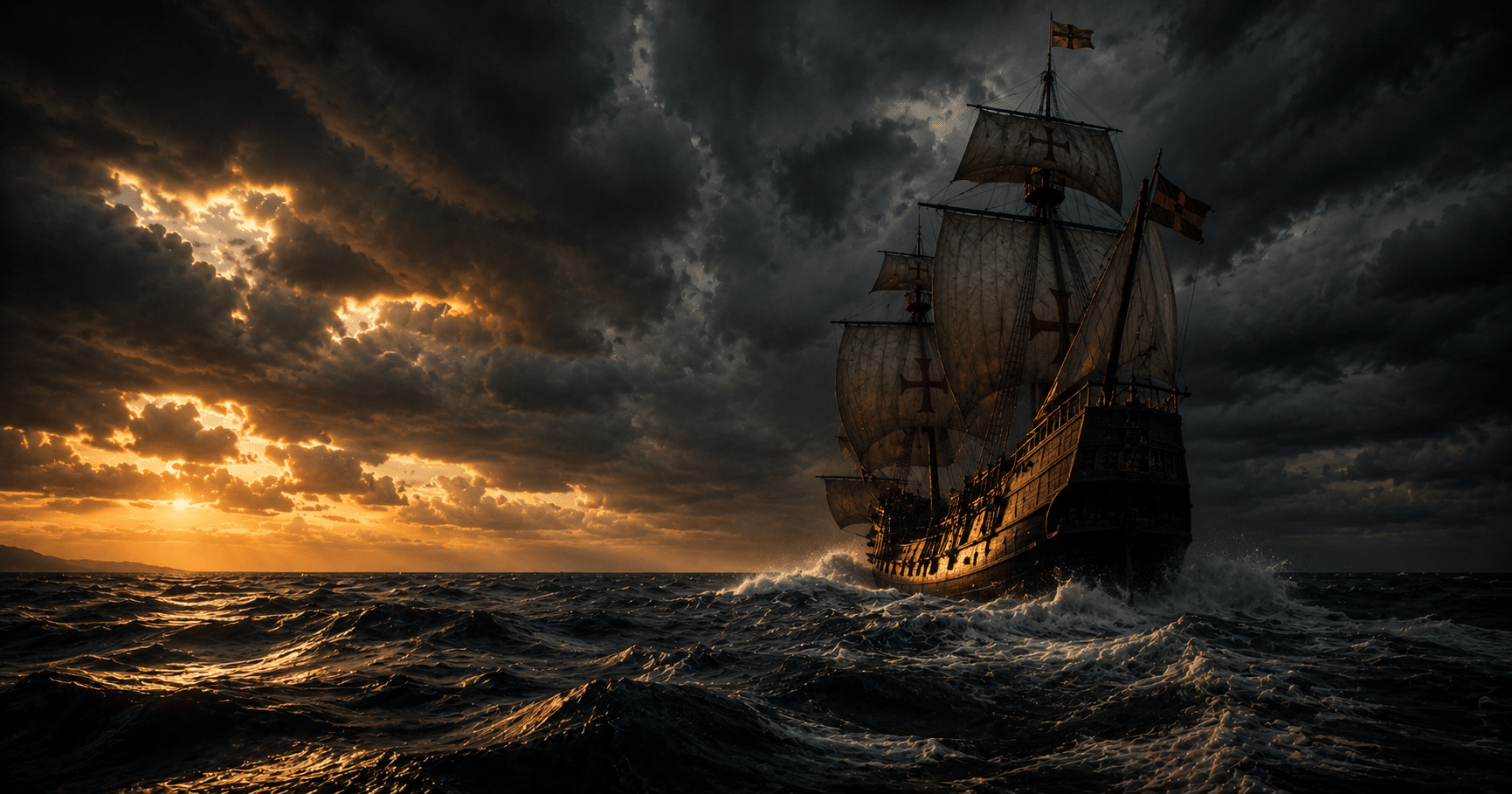
Long before satellites, GPS, radar, engines, weather forecasts, or modern maps… there were men willing to sail directly into the unknown with nothing but wooden ships, primitive instruments, faith, fear, and an impossible dream burning inside them.
One of those men was Christopher Columbus.
History remembers his name. Entire generations grew up hearing about his voyages. But few truly stop to imagine the terrifying reality of what he and his crew actually faced. This was not tourism. This was not exploration with modern safety and technology. This was human beings sailing toward endless black water with no certainty they would ever see home again.
The world in the late 1400s was brutal, dangerous, and filled with mystery. Oceans were feared. Storms could erase entire ships in minutes. Men disappeared into the sea forever without a trace. Sailors spoke in whispers about monsters, endless darkness, cursed waters, starvation, and ships swallowed by storms that looked like the wrath of God Himself.
And still… Columbus went.
Born in Genoa, Italy, into humble beginnings, Columbus became obsessed with the sea at an early age. The ocean called to him long before history ever knew his name. While most men accepted the boundaries of the known world, Columbus became consumed by the idea that there was more beyond the horizon. Something inside him refused to believe humanity had already discovered everything worth discovering.
That kind of vision is dangerous.
Because people laugh at visionaries before they celebrate them.
For years, Columbus faced rejection after rejection. Kings denied him. Advisors mocked him. Experts told him his calculations were wrong. Many believed his journey would end in death somewhere beyond the edge of the known world. But obsession can become stronger than fear in certain men. The dream consumed him until turning back became impossible.
Finally, after years of failure, Spain agreed to support the voyage.
Three ships.
The Niña.
The Pinta.
The Santa María.
Tiny wooden vessels compared to the massive power of the ocean surrounding them. Fragile against storms. Fragile against nature itself. And inside them stood exhausted men preparing to disappear into waters no European crew had ever crossed that way before.
Think about the darkness of that journey.
Weeks trapped at sea with nothing around them but endless black water and sky. No engines. No rescue coming if something failed. No communication with the world behind them. Just creaking wood, violent storms, hunger, sickness, fear, and silence.
Every sunrise must have felt uncertain. Every storm must have sounded like death approaching across the waves.
The farther they sailed, the more terrified the crew became.
Men began losing hope. Some believed Columbus had doomed them all. Supplies ran low. Morale collapsed. Whispers of mutiny spread through the ships. Sailors begged to turn back before the ocean swallowed them forever. They had no proof land even existed ahead. Only Columbus’ relentless belief pushing them deeper into darkness.
And yet he continued forward.
That may be one of the most powerful lessons in human history.
Sometimes courage is not the absence of fear. Sometimes courage is sailing directly into fear while every voice around you screams to turn back.
Night after night, Columbus stood beneath dark skies staring into the unknown while carrying the weight of every life aboard those ships. One wrong decision and all of them would die nameless in the middle of the Atlantic Ocean.
Then finally…
Land.
After weeks that must have felt like an eternity, they saw it. A shoreline emerging from the darkness like a miracle. Palm trees. Sand. A world no one on those ships had ever seen before.
That moment changed history forever.
The voyage opened the door to an entirely new era of exploration and transformed the course of civilization itself. But history often simplifies the emotional reality behind great moments. It forgets the fear. The isolation. The psychological torment. The crushing uncertainty men endured while stepping into the unknown.
Columbus was not a perfect man. Like many figures in history, his legacy remains deeply controversial and complicated. Human ambition often collides with human flaws. But regardless of how history debates him, the courage of those voyages cannot be denied.
Men crossed an ocean with almost no certainty of survival because they believed there was something beyond the horizon worth finding.
And maybe that is why this story still speaks to humanity centuries later.
Because every person eventually faces an ocean of uncertainty in life.
A dark season.
A terrifying decision.
A moment where safety says “turn back” but something deep inside says “keep going.”
Most people stay near the shore their entire lives because fear becomes stronger than possibility.
But history remembers the men willing to sail into darkness searching for light.
Restored Life After