
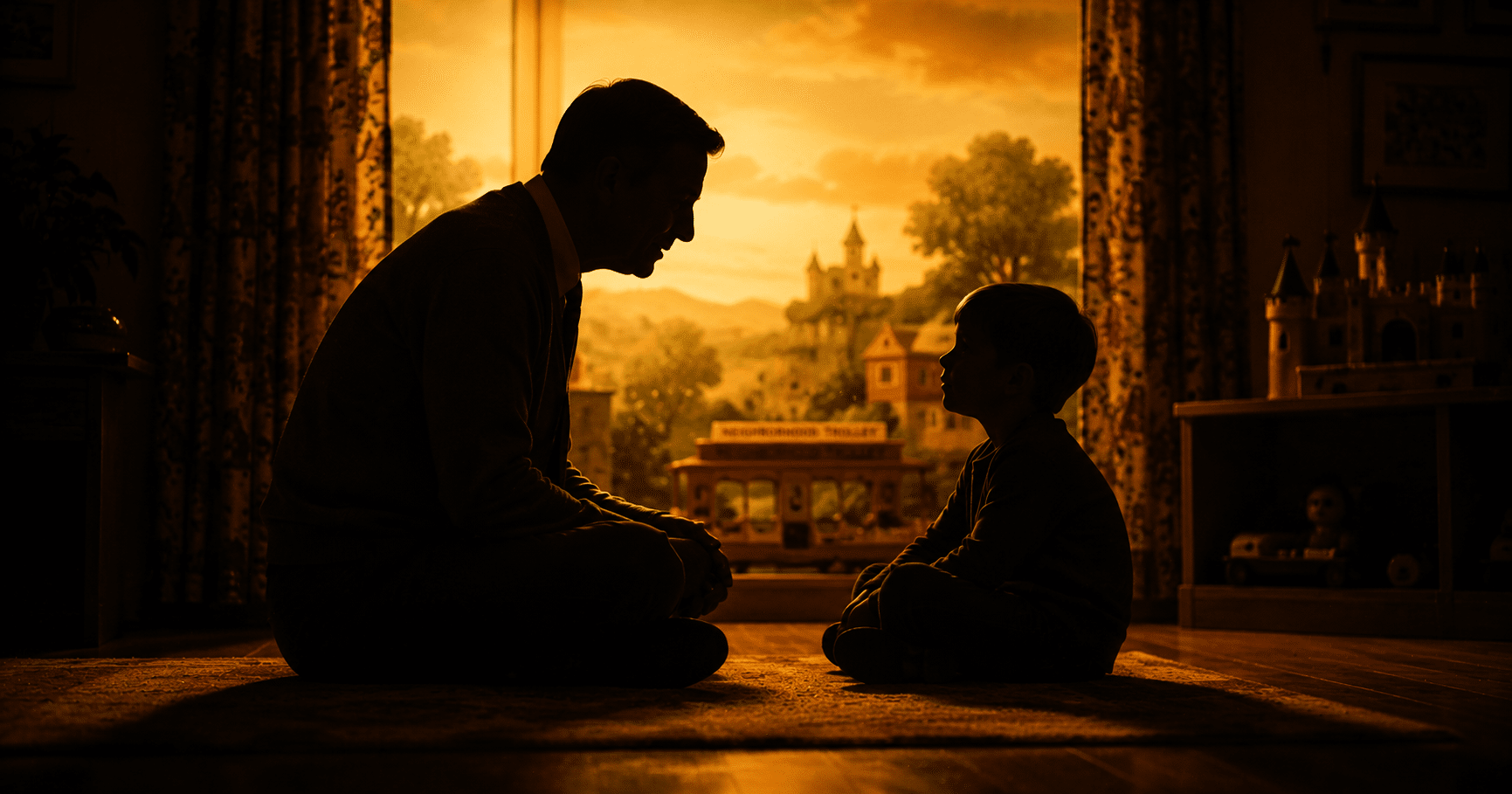
When a world growing louder, colder, and more divided by the day… there once lived a man who quietly dedicated his entire life to teaching children something many adults still struggle to understand:
You are loved exactly as you are.
Fred Rogers — known to generations simply as Mister Rogers — never looked like a revolutionary. He did not carry political power. He was not a war hero. He did not dominate headlines with scandal, wealth, or controversy.
He wore soft sweaters.
Changed into sneakers.
Spoke gently.
Moved slowly.
Listened carefully.
And somehow… in a world obsessed with noise, speed, and image… that quiet kindness changed millions of lives.
But the deeper truth about Mister Rogers is that his life was far more powerful than most people realized.
Because Fred Rogers understood something dangerous about the world:
Children are listening to everything.
Not just words.
But tone.
Anger.
Fear.
Violence.
Rejection.
Love.
Patience.
The way adults treat one another.
And he believed childhood was sacred.
Born in 1928 in Latrobe, Pennsylvania, Fred Rogers was a shy, overweight, lonely child who often felt isolated from others. He struggled socially and spent much of his early life battling insecurity. Other children teased him. He retreated inward. Music became one of his safe places. So did imagination.
Those early wounds mattered.
Because children who know pain often grow into adults capable of recognizing it in others.
Years later, Rogers would say:
“Anything mentionable is manageable.”
That idea became one of the foundations of his life’s work.
Unlike many adults who avoided difficult conversations with children, Mister Rogers believed children deserved honesty wrapped in love. He believed fear grows stronger in silence.
And then television entered his life.
At first, Rogers hated what he saw on TV. He once witnessed a program where adults threw pies at one another for laughs, and he was deeply disturbed by the emptiness and cruelty he saw in much of children’s entertainment.
So he made a decision that would define his life:
If television was going to shape children…
then he would try to use it for good.
That simple choice changed history.
Most people remember Mister Rogers’ Neighborhood as gentle and comforting. But what many never realized was how radical the show truly was beneath the surface.
Fred Rogers spoke directly to children about fear.
About divorce.
About loneliness.
About anger.
About death.
About disability.
About war.
About racism.
About self-worth.
And he did it without mocking them, manipulating them, or treating them as less intelligent because they were young.
That alone separated him from almost everything else on television.
He looked directly into the camera as if he were speaking to one child alone — the lonely child, the scared child, the bullied child, the child sitting quietly in a broken home needing someone to tell them they mattered.
And millions believed him.
Because he meant it.
One of the most powerful things about Fred Rogers was that kindness for him was not weakness.
It was discipline.
Every word on his program was carefully chosen. Scripts were rewritten repeatedly because Rogers understood how deeply children absorb language. He studied child psychology intensely. He cared about emotional safety. He cared about how children processed pain.
He once said:
“Deep and simple is far more essential than shallow and complex.”
That philosophy shaped everything he created.
During one of America’s darkest moments — after the assassination of Robert F. Kennedy — racial tensions and division exploded across the country. Television itself was still heavily segregated.
Then Mister Rogers did something small that became historically powerful.
On his show, he invited Officer Clemmons, a Black police officer played by François Clemmons, to sit beside him and cool his feet together in the same small pool on a hot day.
To modern audiences, it may seem simple.
But during that era, public segregation and racism still poisoned much of America. Even swimming pools had become symbols of division and hatred.
Fred Rogers quietly destroyed part of that hatred without preaching politics, screaming slogans, or humiliating anyone.
Just two human beings sharing kindness.
That was his power.
He believed gentleness could confront darkness more effectively than rage.
And perhaps the reason Mister Rogers affected so many people so deeply is because children instinctively knew he was real.
There was no performance behind the kindness.
No hidden cruelty.
No ego.
No fake persona created for ratings.
The same man seen on television was the same man off camera.
Crew members, actors, friends, and even strangers repeatedly described Fred Rogers as genuinely compassionate, deeply spiritual, humble, disciplined, and emotionally present. He prayed regularly for people by name. He remembered details about others’ lives. He answered letters personally.
And the letters he received from children and adults were overwhelming.
People wrote to him about depression.
Suicide.
Addiction.
Abuse.
Fear.
Loneliness.
Many said Mister Rogers was the only adult in their childhood who ever made them feel safe.
Think about that.
In a world filled with wealth, celebrities, power, and endless entertainment… one of the most beloved men in America became famous simply because he made people feel seen.
That reveals something heartbreaking about humanity.
Sometimes the greatest gift a person can offer another human being is not money, status, or success.
Sometimes it is simply kindness.
As the years passed, the world around Mister Rogers changed dramatically. Television became louder. Faster. More cynical. Violence increased. Attention spans collapsed. Shock value became profitable.
Yet Fred Rogers never changed who he was.
He refused to surrender gentleness to a culture growing increasingly cold.
And perhaps that was his greatest act of courage.
Because it takes enormous strength to remain soft-hearted in a hard world.
Late in life, Rogers delivered one of the most emotional speeches ever given when he accepted a Lifetime Achievement Award. Standing before a room filled with powerful celebrities and industry figures, he asked everyone to spend ten seconds thinking about the people who had loved them into existence.
The room fell silent.
Some cried openly.
Because Fred Rogers understood something many people forget:
No human being becomes whole alone.
Someone encouraged you.
Someone sacrificed for you.
Someone prayed for you.
Someone loved you when you were broken.
And maybe that is why Mister Rogers still matters today more than ever.
Because modern society often teaches people to become harder, colder, louder, crueler, more selfish, more disconnected.
But Fred Rogers spent his life teaching the opposite.
Slow down.
Listen carefully.
Protect children.
Speak gently.
Choose kindness.
Tell the truth.
Care for people.
And never underestimate the wounds hidden inside another human being.
He once said:
“There are three ways to ultimate success:
The first way is to be kind.
The second way is to be kind.
The third way is to be kind.”
Simple words.
But perhaps some of the deepest truths in life are simple.
Fred Rogers died in 2003 from stomach cancer. But even after his death, generations continue discovering him because authentic goodness leaves a mark the world cannot erase.
And maybe that is the true reason his story belongs in Restored Life After.
Because Fred Rogers proved that not all heroes fight with weapons.
Some fight darkness with compassion.
Some protect innocence.
Some restore hope quietly.
Some heal wounds nobody else can see.
And in a world becoming increasingly cruel…
Mister Rogers chose love anyway.