
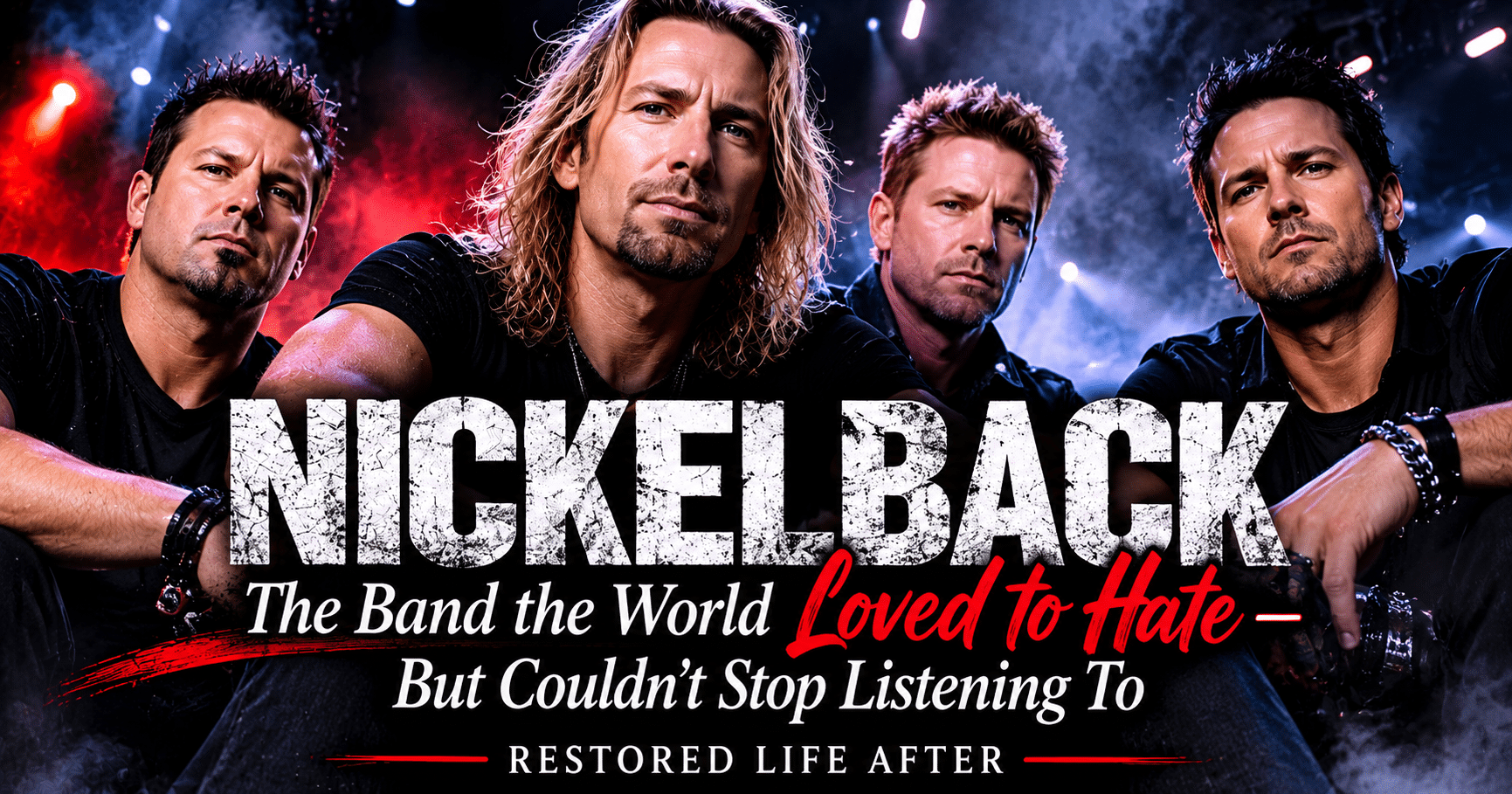
They came from a small Canadian town with big dreams, borrowed money, and little reason to believe the world would ever know their names.
They would go on to sell more than 50 million records worldwide, fill arenas, dominate radio, and become one of the most commercially successful rock bands of their generation.
But there was another side to their success.
The bigger they became, the louder the criticism grew.
They were mocked, ridiculed, and turned into an internet punchline.
Yet millions continued buying their music.
This is the true story of Nickelback — a band that discovered something unusual about fame.
Sometimes the world can love what you create and still make you the target of its cruelty.
Small-Town Beginnings — Hanna, Alberta
Nickelback’s story began in 1995 in Hanna, Alberta, Canada.
Brothers Chad and Mike Kroeger, guitarist Ryan Peake, and drummer Brandon Kroeger formed the early lineup. Before developing their own sound, they played cover songs under the name Village Idiot.
Chad Kroeger was determined to make original music. He borrowed money from his stepfather and headed west to Vancouver, where the group began building its future.
Their first recordings were made on limited resources, without the machinery of a major record label behind them.
They released Curb in 1996 and later The State, gradually attracting attention from Canadian radio stations.
The band members took on business responsibilities themselves, contacting radio programmers, arranging shows, and getting their music into stores.
Before millions heard their songs, they had to convince a few people to listen.
Where Did the Name Nickelback Come From?
The name had nothing to do with rock music.
Mike Kroeger worked at a coffee shop, where he regularly returned small amounts of change to customers.
The phrase he used when giving someone five cents back inspired the band’s name.
Nickelback.
A simple expression from an ordinary job became a name recognized around the world.
2001 — The Song That Changed Everything
In 2001, Nickelback released Silver Side Up, the album that transformed their career.
Its defining single, “How You Remind Me,” became an international hit.
The song’s emotional frustration, recognizable guitar sound, and Chad Kroeger’s gravelly vocals connected with an enormous audience.
It reached number one on the Billboard Hot 100 and became one of the defining rock songs of the decade.
It was also recognized as the most-played song on American radio during the 2000s.
The struggling band from Alberta had become a worldwide phenomenon.
But success was about to bring an entirely different kind of pressure.
The Rise to Superstardom
Nickelback followed their breakthrough with a series of hugely successful albums.
In 2003, The Long Road featured songs including “Someday” and “Figured You Out.”
In 2005, All the Right Reasons became one of their signature albums, featuring “Photograph,” “Far Away,” “Rockstar,” and “Savin’ Me.”
In 2008, Dark Horse continued their commercial success with heavier rock tracks and radio-friendly hits.
By the end of the decade, Billboard had recognized Nickelback as its top rock group of the 2000s.
They had achieved the kind of success most musicians only dream about.
The Band Everyone Loved to Hate
Something strange happened as Nickelback became more successful.
Their music remained enormously popular, yet criticizing the band became fashionable.
Music critics attacked their songwriting as repetitive. Others dismissed their sound as overly commercial.
Eventually, jokes about Nickelback spread across the internet.
The band’s name became shorthand for music people were supposed to dislike.
But the numbers told another story.
Millions purchased their records. Fans packed their concerts. Their songs remained staples of rock radio.
The public criticism was loud. The audience buying tickets was enormous.
This contradiction became one of the most recognizable aspects of Nickelback’s career.
Their story illustrates how public reputation and actual popularity can be very different things.
Behind the Music — Heartbreak, Regret, and Loss
Although Nickelback became known for hard-rock anthems and party songs, some of their most memorable recordings explored much darker emotions.
“How You Remind Me” expressed bitterness and frustration in a troubled relationship.
“Photograph” looked backward toward youth, old friendships, and memories that could never be relived.
“Far Away” explored love, separation, and longing.
“Savin’ Me” presented themes of desperation and the desire for rescue.
Their songs frequently dealt with mistakes, relationships, regret, and the consequences of human decisions.
Behind the distorted guitars were subjects familiar to almost everyone.
Love can hurt. Time cannot be reversed. And some mistakes leave memories that follow us for years.
The Changes Behind the Band
Nickelback also experienced personnel changes.
Early drummer Brandon Kroeger was succeeded by Ryan Vikedal, who played during the band’s rise to international fame.
In 2005, Daniel Adair, formerly of 3 Doors Down, joined the group.
The lineup of Chad Kroeger, Mike Kroeger, Ryan Peake, and Daniel Adair became the band’s long-running configuration.
Through changing musical trends, criticism, and the decline of traditional rock radio’s dominance, Nickelback continued recording and performing.
Recognition After Years of Criticism
In 2007, Nickelback was inducted into Canada’s Walk of Fame.
In 2023, they were inducted into the Canadian Music Hall of Fame.
Their career achievements include twelve JUNO Awards, nine Grammy nominations, and worldwide sales exceeding 50 million records.
Their 2022 album Get Rollin’ also demonstrated that the band could still attract attention decades after its breakthrough.
The song “San Quentin” returned Nickelback to the American rock charts.
They had endured the jokes, the criticism, and the changing music industry.
And their music continued to find listeners.
The Lesson Behind Nickelback’s Story
Nickelback’s history is not a story of perfection.
It is a story of ambition, hard work, commercial success, public criticism, and persistence.
They were not universally admired.
They were not protected from ridicule by their fame.
But they did not need unanimous approval to build an extraordinary career.
There is a lesson here that reaches beyond music.
You can spend your entire life trying to make everyone like you, and there will still be people who criticize you.
Success does not eliminate rejection.
Money does not guarantee respect.
And popularity does not protect anyone from harsh judgment.
The question is whether you allow that judgment to determine the direction of your life.
Final Thought — You Cannot Please the World
Imagine selling millions of records, performing before packed arenas, and hearing your songs played across the planet.
Now imagine becoming the subject of endless ridicule despite those accomplishments.
That is part of Nickelback’s remarkable story.
Some people loved their music.
Others couldn’t stand it.
And many simply joined the jokes.
But the band kept going.
The world will praise you one day and criticize you the next. If you build your identity on its approval, you will never find lasting peace.
There is a greater lesson for all of us.
Don’t confuse applause with character. Don’t confuse criticism with failure. And never allow the opinions of strangers to become the measure of your worth.
Galatians 1:10 asks whether we seek to please people or serve Christ.
It is a reminder that the approval of the world must never become our highest purpose.
Be genuine. Remain humble. Stand for what is right. And remember that your life is worth more than someone else’s opinion of it.
Because when the music stops, the crowds disappear, and the spotlight fades, what remains is not how loudly the world applauded.
It’s the life you lived and the person you became.
RESTORED LIFE AFTER
Tighten Repeated Success ThemesSeparate Facts From Personal Reflection