
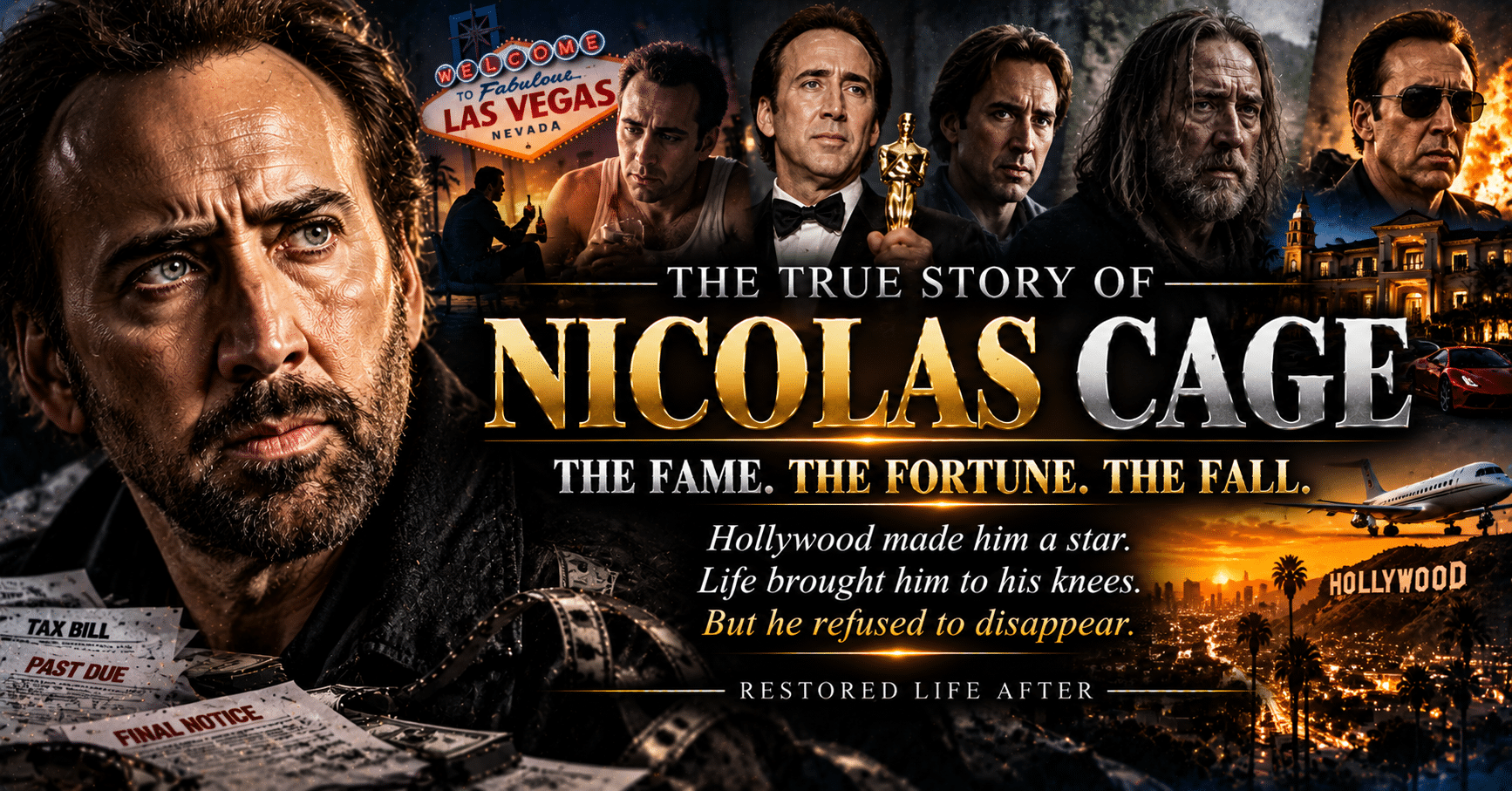
He was born into Hollywood royalty but changed his name to make it on his own. He became an Academy Award winner, one of the highest-paid actors in the world, and a man who seemingly had everything. Then came the extravagant spending, financial disasters, broken marriages, personal tragedies, and years when Hollywood treated him like a punchline. But beneath the wild performances and eccentric reputation was a man who refused to let failure write the final chapter of his life.
THE BOY WHO REFUSED TO LIVE IN SOMEONE ELSE’S SHADOW
Before the world knew him as Nicolas Cage, he was Nicolas Kim Coppola.
Born January 7, 1964, in Long Beach, California, he came from one of Hollywood’s most influential families.
His uncle was legendary filmmaker Francis Ford Coppola, the director of The Godfather and Apocalypse Now. His father, August Coppola, was a professor of literature, and his mother, Joy Vogelsang, was a dancer and choreographer.
From an early age, Nicolas was surrounded by creativity, cinema, and artistic ambition.
But having a famous last name did not mean he wanted to spend his life standing in another man’s shadow.
He wanted to be recognized for his own talent.
He eventually adopted the professional name Nicolas Cage, drawing inspiration in part from Marvel Comics character Luke Cage and avant-garde composer John Cage.
It was more than a name change.
It was a declaration of independence.
He was born with a famous name, but he wanted to build a reputation that belonged to him.
He began acting as a teenager, determined to establish himself through his performances rather than his family connections.
And before long, Hollywood began noticing something unusual.
This young actor was not interested in being ordinary.
He was intense, unpredictable, emotional, and sometimes completely outrageous.
But he was also fearless.
THE RISE: HOLLYWOOD DISCOVERS A DIFFERENT KIND OF STAR
During the 1980s, Cage built his career through films that demonstrated his unusual range.
He appeared in Valley Girl in 1983, Raising Arizona in 1987, and Moonstruck, also released in 1987.
In Moonstruck, starring opposite Cher, Cage played Ronny Cammareri, a passionate, emotionally wounded baker whose intensity helped make the romantic comedy unforgettable.
His performances were not always subtle.
Sometimes they were strange.
Sometimes they were explosive.
But they were rarely forgettable.
Cage developed a reputation for taking risks other actors might avoid.
He was willing to look ridiculous, vulnerable, frightening, or completely unhinged if he believed it served the character.
While other actors carefully protected their public image, Cage often appeared willing to destroy his.
And that fearlessness became one of his greatest strengths.
Sometimes the very qualities that make people misunderstand you are the qualities that eventually set you apart.
But Cage was only beginning to discover how high Hollywood could lift him.
And how far it could allow him to fall.
LEAVING LAS VEGAS: THE ROLE THAT CHANGED EVERYTHING
In 1995, Nicolas Cage delivered one of the most devastating performances of his career.
In Leaving Las Vegas, he portrayed Ben Sanderson, an alcoholic screenwriter who travels to Las Vegas with the intention of drinking himself to death.
The film was painful, intimate, and deeply disturbing.
Cage did not portray alcoholism as glamorous.
He portrayed a man being consumed by addiction, loneliness, and despair.
The character had lost his direction, his relationships, and much of his desire to continue living.
And Cage’s performance was extraordinary.
In 1996, he won the Academy Award for Best Actor.
The young man who had changed his last name to escape comparisons with his famous uncle was now standing on Hollywood’s biggest stage, holding an Oscar of his own.
He had made it.
He was no longer simply a member of the Coppola family.
He was Nicolas Cage.
But there is something worth remembering about success: Reaching the top of the mountain does not mean you are protected from the fall.
And for Cage, the next chapter would bring extraordinary wealth, enormous fame, and decisions that would eventually threaten everything he had built.
THE KING OF HOLLYWOOD: WHEN EVERYTHING TURNED TO GOLD
After winning his Oscar, Cage became one of Hollywood’s most sought-after leading men.
He starred in a remarkable series of blockbuster films, including The Rock in 1996, Con Air and Face/Off in 1997, and Gone in 60 Seconds in 2000.
Audiences loved him.
He could play a hardened criminal, a desperate hero, a romantic leading man, or a character so unpredictable that viewers never knew what he might do next.
In 2004, he starred in National Treasure, introducing another generation to his unusual charm and adventurous personality.
He was earning enormous paychecks, with some reported salaries reaching $20 million per film.
Cage had achieved the kind of success most actors could only dream about.
But behind the fortune was a growing fascination with extraordinary possessions.
He purchased expensive homes, castles, exotic collectibles, rare automobiles, and other unusual treasures.
Among his most famous purchases was a dinosaur skull that he later returned after learning it had been stolen from Mongolia.
He also owned property in places such as New Orleans, England, and Germany.
To the outside world, his lifestyle seemed almost unbelievable.
But a dangerous financial reality was developing beneath the surface.
The problem with having everything you want is that sometimes you stop recognizing how much everything costs.
And when the financial markets changed, Cage would discover that even a Hollywood fortune could disappear.
THE FINANCIAL COLLAPSE: WHEN MILLIONS WERE NOT ENOUGH
The late 2000s brought serious financial trouble.
Cage had invested heavily in real estate, and the collapse of the property market left him exposed to enormous losses.
He also faced substantial tax liabilities and debts.
Headlines began appearing about his properties, his spending, and his financial problems.
The same newspapers that had celebrated his success now seemed fascinated by his downfall.
His personal life became a public spectacle.
But in a 2023 interview with 60 Minutes, Cage explained that the financial crisis was largely connected to his real estate investments.
He said he had owed approximately $6 million to the IRS and creditors, and that he eventually paid those obligations without filing for bankruptcy.
Think about that.
A man who had earned extraordinary amounts of money found himself working to escape enormous debt.
He had become wealthy enough to purchase almost anything, yet not financially secure enough to escape the consequences of his decisions.
There is a lesson in that story that reaches far beyond Hollywood.
Money does not automatically create wisdom.
A large income does not guarantee financial freedom.
And owning expensive possessions does not mean those possessions are making your life better.
Sometimes the things we purchase to demonstrate our success become the very things that threaten our peace.
Cage was facing a choice.
He could allow the financial disaster to destroy his career.
Or he could go back to work.
He chose to work. <Cite refs={[“turn901248search0″,”turn901248search6”]}/>
THE YEARS HOLLYWOOD LAUGHED AT HIM
During the following years, Nicolas Cage appeared in an extraordinary number of films.
Some were successful.
Others received terrible reviews.
Many were low-budget productions that attracted little attention outside their audiences.
Critics questioned why an Academy Award-winning actor was accepting so many roles.
Internet memes turned his exaggerated facial expressions and unusual performances into endless jokes.
For some people, Nicolas Cage was no longer a respected actor.
He had become entertainment for an entirely different reason.
People laughed at his movies.
They mocked his choices.
They questioned whether his best years were behind him.
But behind those headlines was a man determined to meet his financial obligations.
Cage later explained that work helped him survive that difficult period. He also defended his commitment to acting, maintaining that he continued taking his performances seriously even when the finished films disappointed audiences.
There is something powerful about a person who refuses to quit simply because the world has stopped applauding.
It is easy to celebrate someone when everything is going right.
It is easy to admire a person standing on top of the mountain.
But character is often revealed when the money disappears, the criticism begins, and the people who once praised you suddenly turn away.
Cage kept working.
Movie after movie.
Year after year.
And slowly, the financial pressure began to ease.
Sometimes rebuilding your life is not glamorous. Sometimes it means getting up every morning, swallowing your pride, and doing the work nobody wants to celebrate. <Cite refs={[“turn901248search0″,”turn901248search2”]}/>
THE MAN BEHIND THE WILD PERSONALITY
Nicolas Cage’s personal life has often been as unpredictable as his films.
He has been married five times, including marriages to actresses Patricia Arquette and Lisa Marie Presley, the daughter of Elvis Presley.
His relationships attracted intense public attention, particularly his brief marriage to Presley and his four-day marriage to Erika Koike in 2019, which ended in an annulment.
In 2021, Cage married Riko Shibata.
He is also the father of three children.
His life has included family changes, public scrutiny, and the challenge of maintaining personal relationships while living under Hollywood’s spotlight.
But it would be unfair to reduce an entire human being to a collection of tabloid headlines.
The public sees photographs, interviews, marriages, divorces, and movie premieres.
It does not see every private conversation.
It does not know every disappointment.
It does not understand every personal struggle.
And it certainly does not know everything happening inside another person’s heart.
We live in a world that loves watching people fall, but rarely stops to consider how much pain may exist behind the spectacle.
A famous person can become so familiar to the public that people forget they are human.
They become a character.
A joke.
A headline.
Something to discuss.
But behind the name Nicolas Cage is still a father, a husband, a son, and a man who has experienced both extraordinary success and painful setbacks. <Cite ref=”turn901248search1″/>
THE COMEBACK: WHEN HOLLYWOOD REMEMBERED HIS TALENT
Over time, Cage began receiving renewed recognition for his acting.
His performance in Mandy in 2018 reminded audiences how effectively he could combine emotional intensity with unusual storytelling.
Then came Pig in 2021.
In that film, Cage portrayed a reclusive former chef living in the Oregon wilderness who searches for his stolen truffle pig.
The premise sounded unusual.
But the film was not simply about an animal.
It was about grief.
Loss.
Loneliness.
And the terrible emptiness that remains when someone you love is no longer there.
Cage delivered a restrained, deeply emotional performance that earned widespread praise.
The man who had become famous for explosive acting showed the world that he could communicate devastating pain through silence.
He later described Pig as one of his most personally meaningful performances.
In 2022, he starred in The Unbearable Weight of Massive Talent, playing a fictionalized version of himself and demonstrating that he could laugh at his own public image.
Then came Dream Scenario in 2023 and the horror film Longlegs in 2024.
Once again, audiences and critics were talking about Nicolas Cage’s talent.
Not merely his eccentricities.
Not simply his financial troubles.
His talent.
The man Hollywood had turned into a joke had reminded the world why he became a star in the first place.
But perhaps the most important victory was not another successful movie.
It was the fact that he had survived the years when success seemed far away. <Cite refs={[“turn901248search2″,”turn901248search27”]}/>
2026: STILL REFUSING TO DISAPPEAR
As of October 2026, Cage is 62 years old and remains active in film and television.
He starred in Spider-Noir, taking on another unusual character in a career filled with unexpected choices.
He has also worked on Madden, portraying legendary football coach and broadcaster John Madden, and continued pursuing new projects.
In October 2026, he was filming the post-apocalyptic thriller Parish in Minnesota.
More than four decades after his early Hollywood appearances, he is still working.
Still experimenting.
Still taking risks.
Still refusing to become predictable.
And perhaps that is the most remarkable part of his story.
Cage has experienced the kind of fame that few people ever achieve.
He has also experienced financial pressure, public ridicule, and professional disappointment.
Yet he continued doing the work he loved.
The world tried to define him by his strangest performances, his financial troubles, and his mistakes. But he continued writing a story that was bigger than any single chapter. <Cite refs={[“turn901248search3″,”turn901248search8″,”turn901248search9”]}/>
THE FINAL TRUTH: YOU ARE MORE THAN YOUR WORST CHAPTER
Nicolas Cage’s life is a remarkable story of talent, ambition, extravagance, financial collapse, public humiliation, and perseverance.
He was born into a famous family but fought to create his own identity.
He became an Academy Award winner and one of Hollywood’s biggest stars.
He accumulated enormous wealth, then faced financial consequences that forced him to reconsider his circumstances.
He endured criticism and became the subject of countless jokes.
But he kept working.
And eventually, he rebuilt much of what had been damaged.
There is a lesson here for every person who has ever made a mistake, lost money, experienced failure, or felt that the world had given up on them.
Your past does not have to become your permanent identity.
A financial mistake does not mean you are incapable of rebuilding.
A broken relationship does not mean your life has no future.
And falling from a place of success does not mean you can never rise again.
But there is an even deeper truth.
The world measures success through money, fame, possessions, and recognition.
God measures things differently.
Jesus asked in Mark 8:36 (KJV):
“For what shall it profit a man, if he shall gain the whole world, and lose his own soul?”
Think about those words.
You can become famous.
You can become wealthy.
You can own castles, expensive cars, and possessions most people will never afford.
You can have millions of people recognize your face.
But none of those things can purchase another day of life.
None can guarantee peace.
And none can save your soul.
The Bible tells us in 1 Timothy 6:6–7 (KJV):
“But godliness with contentment is great gain. For we brought nothing into this world, and it is certain we can carry nothing out.”
These Scriptures are not judgments about Nicolas Cage’s personal faith or spiritual condition. They are reminders for all of us as we consider the choices, victories, and struggles that shape a human life.
The greatest danger is not losing your fortune. It is becoming so consumed with gaining the world that you forget what truly matters.
Work hard.
Use your talents.
Pursue your dreams.
But never confuse possessions with peace, fame with fulfillment, or success with salvation.
And when life knocks you down, do not allow shame to convince you that your story is finished.
Get up.
Accept responsibility.
Learn from your mistakes.
Do the work.
And remember that the applause of the world is temporary.
Nicolas Cage spent decades proving that he was more than a famous last name, more than an Oscar, more than a fortune, and more than the mistakes that nearly ruined him.
But the greatest lesson from his story is one that applies to everyone:
You can lose your money and earn it back. You can lose your reputation and rebuild it. You can fall so far that nobody believes you will rise again. But never become so focused on reclaiming the world that you neglect the one thing more valuable than everything in it—your soul.
Because when the cameras stop rolling, the lights go dark, and the world moves on to its next star, what matters most is not how famous you became, but how you lived before God.
RESTORED LIFE AFTER