
On the evening of December 21, 1988, the holiday season was in full swing. Airports around the world buzzed with families eager to reunite for Christmas, college students hurried home after finishing finals, business travelers prepared for one last trip before the year’s end, and children dreamed about presents waiting beneath brightly decorated trees. At Heathrow Airport in London, Pan American World Airways Flight 103 was preparing for what thousands believed would be another routine journey across the Atlantic to New York City before continuing on to Detroit. No one boarding that Boeing 747 had any reason to believe they were walking into history. They laughed with loved ones, hugged family members goodbye, carried wrapped Christmas gifts into the cabin, and looked forward to tomorrow. None of them knew tomorrow would never come.
Pan Am Flight 103 departed Heathrow shortly after 6:25 p.m. local time carrying 243 passengers and 16 crew members. Among those onboard were businessmen, military personnel, tourists, students returning home for the holidays, and children excited to spend Christmas with family. One of the largest groups consisted of 35 Syracuse University students returning from a semester abroad. They had spent months studying in Europe and could hardly wait to tell their families about everything they had experienced. Parents were already preparing meals and decorating homes, watching the clock until they could finally embrace sons and daughters they had missed for months.
For the first thirty-eight minutes, everything appeared perfectly normal. The aircraft climbed smoothly into the dark winter sky, leveling off at 31,000 feet as it crossed northern England toward the Atlantic Ocean. The flight crew communicated routinely with air traffic controllers. The cabin lights glowed softly while passengers settled into their seats. Some watched movies. Others slept. Flight attendants served drinks and prepared for the long journey across the ocean. It was simply another evening flight crossing Europe.
Then, at exactly 7:03 p.m., everything changed.
Hidden inside a portable cassette player packed within a suitcase in the cargo hold was a powerful plastic explosive known as Semtex. It had been carefully concealed months earlier through a sophisticated terrorist operation designed to evade airport security. A timer reached its final second.
The bomb detonated.
The explosion ripped a hole through the left side of the aircraft just beneath the cockpit. The force was catastrophic. Within moments, explosive decompression tore the Boeing 747 apart at over 500 miles per hour. The nose section separated almost instantly while the remainder of the aircraft shattered into thousands of pieces across the freezing Scottish sky. There was no opportunity for a distress call. Air traffic controllers heard only silence. The radar target that had represented Flight 103 simply disappeared.
Below the aircraft lay the quiet town of Lockerbie, Scotland. Families were eating dinner. Children played inside warm homes only days before Christmas. Television sets glowed as neighbors prepared for another peaceful evening.
Then pieces of an airliner began falling from the heavens.
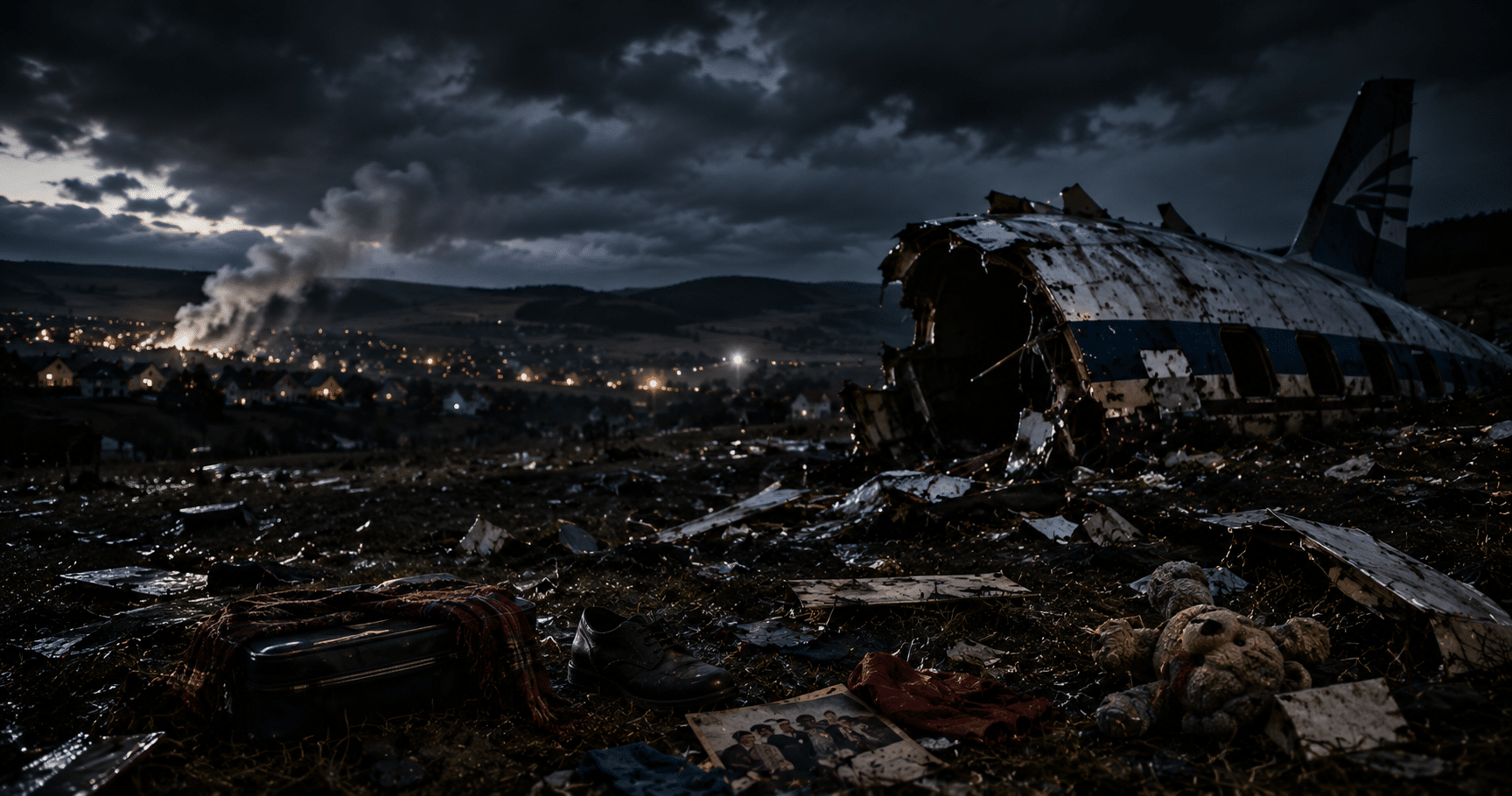
Burning debris rained over more than 800 square miles. Entire sections of the airplane crashed into fields, roads, and neighborhoods. The largest impact occurred in the Sherwood Crescent neighborhood, where the aircraft’s fuel-laden center section slammed into the ground with such incredible force that it created a crater nearly 155 feet wide. Thousands of gallons of jet fuel exploded on impact, destroying homes instantly and creating an enormous fireball visible for miles. The explosion was so powerful that residents initially believed an earthquake or military attack had occurred.
In a matter of seconds, 270 lives were gone.
Every one of the 259 passengers and crew aboard Flight 103 perished. Eleven people on the ground in Lockerbie were also killed as their homes disappeared beneath the inferno. Entire families vanished together. Parents who had been wrapping Christmas presents moments earlier never had the chance to place them beneath the tree. Firefighters and emergency workers rushed toward the flames, but there was nothing they could do except recover victims and comfort survivors whose entire neighborhoods had been destroyed.
The scenes that followed were heartbreaking beyond words. Personal belongings drifted across the Scottish countryside for miles. Children’s toys, family photographs, passports, Christmas cards, wrapped gifts, clothing, wedding rings, and handwritten letters covered fields and forests. Farmers discovered luggage scattered across pastures. Rescue workers carefully collected every piece of evidence they could find while treating every recovered item with dignity, knowing each object represented a life suddenly interrupted.
The investigation became one of the largest criminal inquiries in history. More than 10,000 pieces of debris were painstakingly collected and reconstructed inside a warehouse. Investigators examined millions of fragments, slowly rebuilding sections of the aircraft to determine what had happened. Eventually they located tiny fragments of a cassette player and pieces of a timing device that led investigators toward the truth. The evidence pointed to Libyan intelligence operatives who had orchestrated the bombing as an act of terrorism.
Years of international diplomacy, intelligence gathering, and legal battles followed. In 2001, Abdelbaset al-Megrahi was convicted for his role in the attack after a lengthy international trial. Although another suspect was also charged, the case continued to raise questions for decades regarding who else may have been involved. Libya eventually accepted responsibility for the actions of its officials and agreed to pay billions of dollars in compensation to the victims’ families. Yet no courtroom could ever restore what had been stolen.
The bombing of Pan Am Flight 103 permanently changed aviation security around the world. Airports introduced stricter baggage screening, stronger explosive detection systems, better passenger-to-luggage matching procedures, and increased international intelligence cooperation. Modern airport security, though sometimes frustrating, exists in part because 270 innocent people never made it home that December night.
For the families left behind, life would never return to normal. Christmas became a painful reminder instead of a joyful celebration. Empty chairs sat around dinner tables year after year. Birthdays passed without candles. Weddings occurred without parents. Children grew up without mothers and fathers. The world moved forward, but many hearts remained frozen on December 21, 1988.
Perhaps the greatest tragedy is that every victim had a future waiting for them. There were dreams still unfinished, careers just beginning, marriages still to celebrate, children yet to be born, and conversations that would never happen. Evil did not simply destroy an airplane that night—it interrupted hundreds of stories that were still being written.
History often measures disasters by numbers, but heaven sees names.
Every life aboard Flight 103 mattered. Every smile, every dream, every prayer, every family, every memory had immeasurable value. Terrorism seeks to spread fear through unimaginable cruelty, but it can never erase the worth of the people it steals. Their lives continue to be remembered not because of how they died, but because of how they lived.
The bombing of Pan Am Flight 103 remains one of the darkest acts of terrorism before the attacks of September 11, 2001. It reminds us that evil is painfully real, that hatred has devastating consequences, and that life itself is astonishingly fragile. We are never promised tomorrow. Every goodbye may be more important than we realize. Every embrace matters. Every moment with those we love is a gift that should never be taken for granted.
The people aboard Pan Am Flight 103 boarded an airplane expecting an ordinary journey home for Christmas. Instead, they became part of a story the world would never forget. More than three decades later, their memories still echo across the quiet hills of Lockerbie, where a peaceful town became forever connected to one of history’s greatest tragedies.
May we remember them—not merely as victims of terror—but as fathers, mothers, sons, daughters, friends, students, husbands, wives, neighbors, and fellow human beings whose lives ended far too soon.