
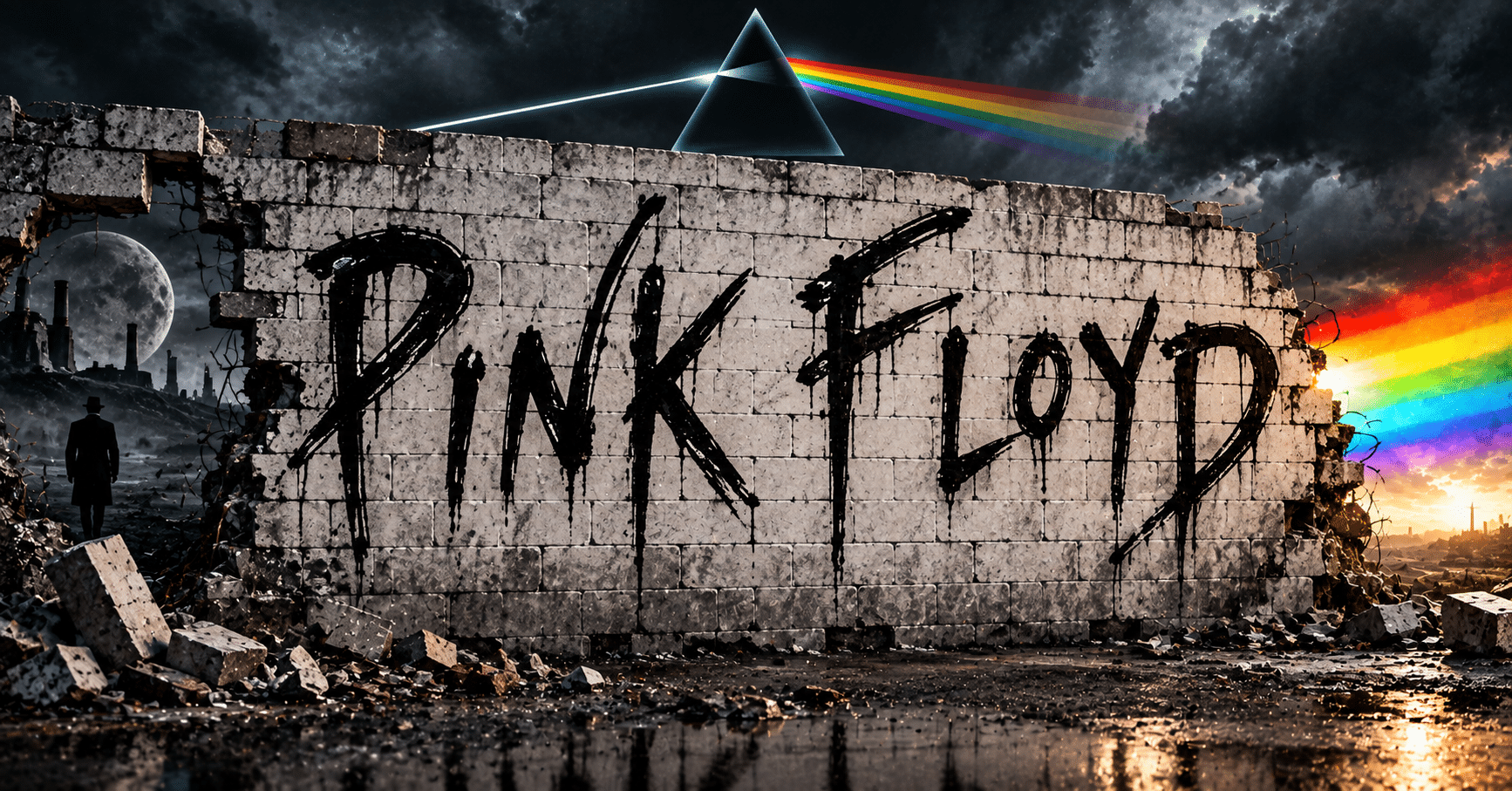
BEHIND THE WALL
Before the giant stadiums, flying pigs, burning businessmen, prisms, walls and albums that would sell by the tens of millions, Pink Floyd was simply a group of young musicians trying to create sounds nobody else was making. The band that became Pink Floyd formed in London in 1965, built around Syd Barrett, Roger Waters, Richard Wright and Nick Mason. Barrett became the group’s early creative force, writing much of their first material and even helping give the band its name by combining the names of blues musicians Pink Anderson and Floyd Council. Their early music was strange, playful and psychedelic, perfectly suited for London’s growing underground scene. Their 1967 debut album, The Piper at the Gates of Dawn, established them as something very different. But almost immediately, the man helping lead Pink Floyd into the future began disappearing inside himself.
SYD BARRETT — THE FIRST TRAGEDY OF PINK FLOYD
Syd Barrett’s deterioration remains one of rock music’s saddest stories. As Pink Floyd’s popularity grew, Barrett became increasingly unpredictable and withdrawn. His heavy use of psychedelic drugs, particularly LSD, has long been associated with this period, although exactly what caused his psychological decline has never been established with certainty. Sometimes he would simply stare into space. Performances became unreliable. The brilliant young songwriter who had helped create Pink Floyd was becoming increasingly unable to function within it. In late 1967, guitarist David Gilmour, an old acquaintance of Barrett’s, was brought into the group. For a short time Pink Floyd had five members, with the hope that Barrett might continue writing while Gilmour handled more of the live performances. It didn’t work. In 1968, the band stopped picking Barrett up for shows. Soon afterward, he was gone from Pink Floyd entirely. He was only in his early twenties. The band moved forward, but the memory of the friend they had lost without actually losing him would haunt their music for years.
FOUR MEN HAD TO BECOME A NEW BAND
With Barrett gone, Pink Floyd had to discover what Pink Floyd was without its original frontman. Roger Waters increasingly became the primary lyricist and conceptual force, while David Gilmour’s guitar and voice became central to the band’s sound. Richard Wright brought keyboards, atmosphere and harmony, while Nick Mason provided the rhythmic foundation underneath increasingly ambitious compositions. Albums including A Saucerful of Secrets, Atom Heart Mother and Meddle showed them moving away from their psychedelic beginnings and toward something larger and more cinematic. Then came a record that changed everything. In 1973 Pink Floyd released The Dark Side of the Moon. It dealt with time, greed, mortality, conflict and mental instability—the pressures that slowly consume human beings. It wasn’t simply a collection of songs. It flowed almost like one continuous thought. The album became one of the most commercially successful and enduring records in music history, spending an extraordinary number of years appearing on the Billboard 200.
THE FRIEND WHO WAS STILL THERE EVEN WHEN HE WAS GONE
Success didn’t make Pink Floyd forget Syd Barrett. If anything, his absence became part of their identity. In 1975 the band began recording Wish You Were Here, an album dealing heavily with absence, alienation and the machinery of the music business. Its centerpiece, “Shine On You Crazy Diamond,” was largely a tribute to Barrett. Then something happened during the recording sessions that became almost unbelievable in Pink Floyd history. On June 5, 1975, Barrett unexpectedly appeared at Abbey Road Studios. He had changed dramatically. He had gained weight, shaved his head and eyebrows, and at first some members of the band reportedly didn’t recognize him. When they finally realized who was standing there, the moment was deeply emotional. They were working on music inspired by the man they had lost—and suddenly that man walked into the room. Barrett eventually left, returned to a private life and largely disappeared from public view. He died in 2006 at age 60. But his shadow never really left Pink Floyd.
WISH YOU WERE HERE
That is part of what gives “Wish You Were Here” such emotional weight. The song became bigger than the circumstances surrounding the album. Its opening guitar feels almost like someone trying to reach another person through distance and static. The lyrics ask whether we can tell what is real from what is false, freedom from confinement, and whether somewhere along the road we traded something genuine for something empty. It became one of Pink Floyd’s most beloved songs because nearly everyone eventually understands what it means to miss someone who is no longer standing beside you. Sometimes they’re dead. Sometimes they’ve walked away. Sometimes they’re physically present but emotionally unreachable. And sometimes, like Syd Barrett, they’re alive somewhere in the world—but the person you once knew seems impossibly far away.
SUCCESS WAS BUILDING ANOTHER KIND OF WALL
Pink Floyd became enormous. Animals arrived in 1977 with a darker, more cynical view of society. But inside the band, Roger Waters was becoming increasingly dominant and increasingly frustrated. During the 1977 tour, Waters became disgusted by the enormous stadium environment and the emotional distance between performer and audience. At one infamous concert in Montreal, he spat at a disruptive fan near the stage. Waters later reflected on the disturbing feeling of wanting a barrier between himself and the audience. From that darkness came one of rock’s most famous concepts: The Wall. Released in 1979, the album told the story of a damaged rock star named Pink who responds to pain, loss, control, broken relationships and isolation by constructing a psychological wall around himself. Songs such as “Another Brick in the Wall, Part 2,” “Comfortably Numb,” “Hey You” and the title concept turned personal isolation into something millions recognized in themselves.
THEN THE WALL BECAME REAL
The tragedy is that while Pink Floyd was creating an album about isolation, the members themselves were becoming increasingly isolated from one another. Richard Wright was pushed out of the band during the making of The Wall, although he later returned as a touring musician and eventually again as a full member. Waters and Gilmour increasingly clashed over creative control and direction. By the time The Final Cut was released in 1983, Pink Floyd barely felt like four men creating together anymore. Waters left the group in 1985, believing Pink Floyd had effectively reached its end. Gilmour and Mason disagreed. A bitter dispute followed over whether the remaining members could continue using the Pink Floyd name. They did. Richard Wright eventually returned, and Pink Floyd continued without Waters, releasing A Momentary Lapse of Reason in 1987 and The Division Bell in 1994. The irony was impossible to miss: the band that had written some of the greatest music ever made about communication, alienation and walls between human beings had built enormous walls between themselves.
ONE MORE TIME
Then, on July 2, 2005, something happened many fans thought they would never see. At the Live 8 benefit concert in London’s Hyde Park, Roger Waters walked onto the same stage with David Gilmour, Richard Wright and Nick Mason. The classic Pink Floyd lineup performed together for the first time in approximately twenty-four years. They played “Speak to Me/Breathe,” “Money,” “Wish You Were Here” and “Comfortably Numb.” Before “Wish You Were Here,” Waters acknowledged the emotion of standing with the other members again and remembered those who weren’t there—especially Syd. For a few minutes, decades of arguments and separation seemed smaller than the music they had created together. At the end, Waters called the others together for a group embrace. It would become the final performance of that four-man lineup.
THE FINAL CHAPTERS
Richard Wright died from cancer in 2008, closing the possibility of another complete reunion. Pink Floyd later released The Endless River in 2014, largely built from material originating in sessions with Wright during the Division Bell era. In 2022, Gilmour and Mason revived the Pink Floyd name for “Hey, Hey, Rise Up!”, recorded in support of Ukraine with Ukrainian singer Andriy Khlyvnyuk. By then Pink Floyd was no longer simply a functioning rock band. It had become something larger—a body of music passed from one generation to another. The prism from The Dark Side of the Moon, the floating pig, the burning man, the marching hammers and the enormous white wall became cultural images recognized even by people born decades after the albums were released.
RESTORED LIFE AFTER
Maybe the deepest Pink Floyd story isn’t about record sales at all. It’s about walls. Syd Barrett disappeared behind one. Roger Waters built them. David Gilmour fought through them. The members spent years separated by them. And millions of listeners heard those songs while living behind walls of their own. We build walls after betrayal. After death. After divorce. After rejection. After someone breaks something inside us that we promised nobody would ever touch again. At first the wall feels like protection. Eventually it can become a prison. The same thing built to keep pain out can keep love, forgiveness and restoration from getting back in.
Pink Floyd spent decades asking questions about time, death, greed, loneliness, madness and what happens when human beings lose connection with one another. Those questions are still worth asking. But there is one question even greater: What are you doing with the time you have left? Because eventually the concert ends. The lights go dark. The crowd goes home. The money belongs to somebody else. The arguments that once seemed enormous become memories. And the people standing beside you today become the people you someday wish were still there.
Don’t wait until someone is gone to realize what they meant to you.
Don’t spend your entire life building walls and then wonder why you’re alone behind them.
Forgive where you can. Love while you can. Make peace while there is still time.
Because eventually every one of us will understand those four simple words:
Wish you were here.
RESTORED LIFE AFTER