
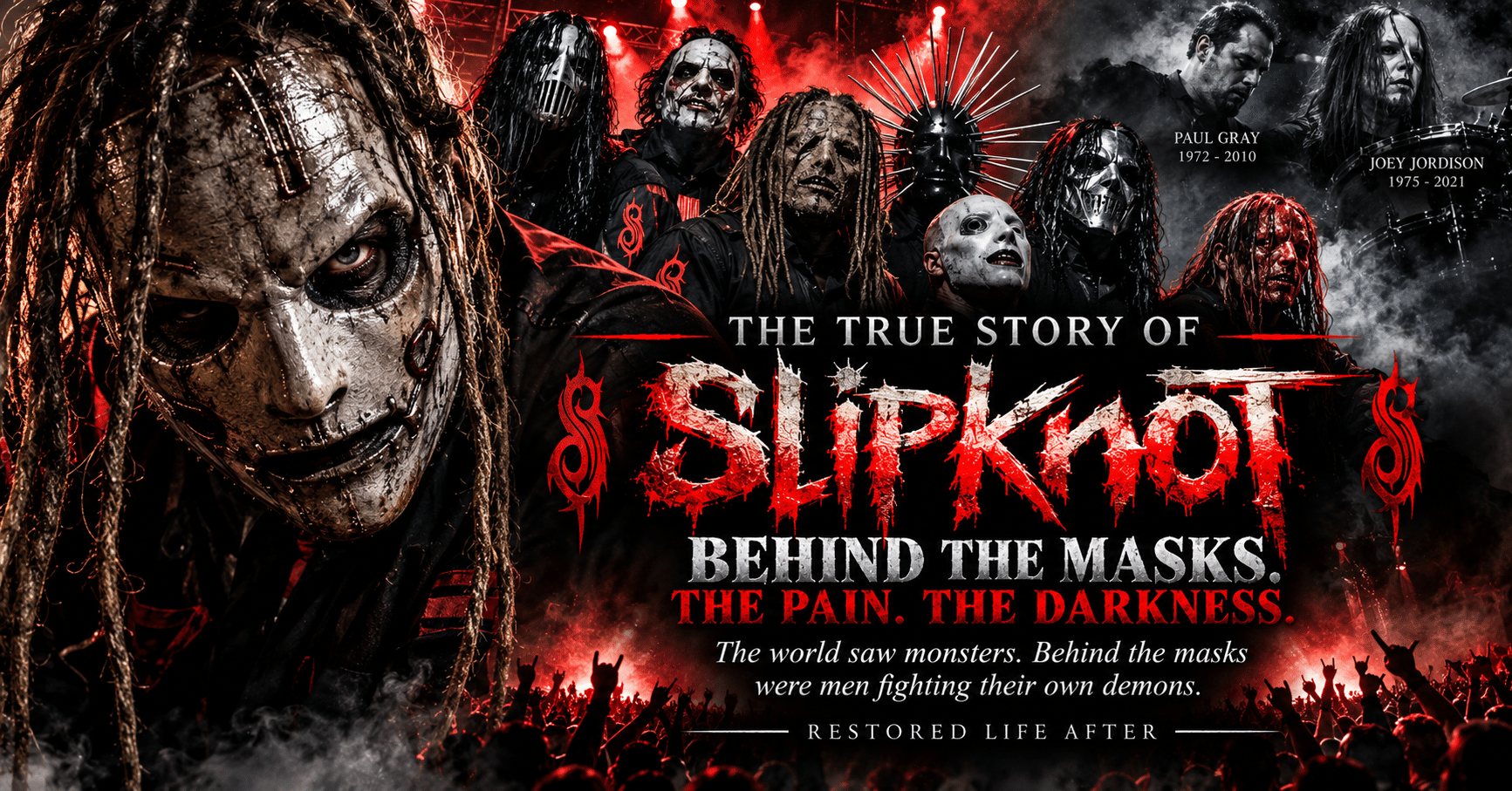
They wore terrifying masks, created some of the most aggressive music the world had ever heard, and built an empire from anger, pain, and rejection. But behind the screaming, the violence of their sound, and the millions of fans stood real men battling addiction, death, personal demons, and the devastating cost of fame.
NINE MEN. NINE MASKS. ONE DARK VISION.
Before the sold-out arenas, the platinum records, and the terrifying masks, there was a group of musicians in Des Moines, Iowa, who wanted to create something the world had never experienced.
In 1995, the early foundations of Slipknot began taking shape. Percussionist Shawn Crahan, bassist Paul Gray, and drummer Joey Jordison were among the musicians who helped build the band’s identity.
They were not coming from Los Angeles or New York, where record executives searched for the next big sensation.
They were coming from Iowa.
A place most people would never have associated with the future of heavy metal.
But perhaps that isolation became part of their strength.
The band developed a sound that combined crushing guitars, violent percussion, electronic noise, unsettling melodies, and vocals that moved between whispers, screams, and raw emotional confession.
Eventually, their classic nine-member lineup included Corey Taylor, Mick Thomson, Jim Root, Craig Jones, Sid Wilson, Chris Fehn, Shawn Crahan, Paul Gray, Joey Jordison, and Chris Fehn’s fellow bandmates—nine musicians working together to create a sound that felt like controlled chaos.
Each member wore a mask.
Each had a number.
And together they became something larger than any individual personality.
The masks were not simply costumes designed to frighten people. They became symbols of anonymity, identity, psychological struggle, and the desire to separate the music from the ordinary faces behind it.
The world saw monsters onstage. But underneath those masks were human beings carrying wounds the audience could not see.
THE MUSIC THAT GAVE ANGER A VOICE
In 1999, Slipknot released their self-titled major-label debut album.
It was explosive.
Songs such as Wait and Bleed, Spit It Out, and Surfacing introduced listeners to a band that seemed to reject nearly every rule of conventional rock music.
Their performances were intense, unpredictable, and physically punishing.
They wore matching jumpsuits. Their masks made them appear almost inhuman. Their stage shows were filled with aggression, movement, and a level of energy that made them impossible to ignore.
But behind the spectacle was something deeper.
Their music connected with people who felt rejected, misunderstood, angry, lonely, or disconnected from the world around them.
For many listeners, Slipknot became an outlet for emotions they did not know how to express.
The band was not offering easy answers.
They were giving pain a voice.
And sometimes that voice was deafening.
There is a reason darkness attracts people who are hurting. When someone finally expresses the anger you’ve been hiding, it can feel as though somebody understands the war taking place inside your own mind.
But understanding pain and escaping it are two very different things.
And for the men behind Slipknot, the battles were only beginning.
IOWA: WHEN THE DARKNESS BECAME EVEN DEEPER
In 2001, Slipknot released their second major album, Iowa.
It was heavier, darker, and more emotionally disturbing than their debut.
The album was born during a difficult period for the band, marked by internal tensions, substance abuse, and the pressure of sudden fame.
Songs such as People = Shit, Disasterpiece, and The Heretic Anthem reflected an atmosphere of anger and alienation.
The record became a commercial success, reaching No. 3 on the Billboard 200.
But the darkness was not merely theatrical.
Members of the band later spoke openly about how destructive that period had become.
The pressure to create something more extreme than their first album was enormous. The musicians were becoming famous, but fame was not solving their personal problems.
There is a terrible illusion that success will heal everything that hurts inside us. But money cannot silence every memory, applause cannot repair every wound, and fame cannot rescue a person from themselves.
Slipknot was becoming one of the biggest metal bands in the world.
Yet some of its members were fighting battles that threatened to destroy them. <Cite refs={[“turn529616search2″,”turn529616search8”]}/>
THE WORLD BEHIND COREY TAYLOR’S SCREAMS
<Entity category=”people” value=”Corey Taylor” disambig=”Slipknot and Stone Sour vocalist”/> became the unmistakable voice of Slipknot.
His ability to move from terrifying screams to deeply emotional singing helped define the band’s sound.
But behind that voice was a man who had experienced serious personal struggles.
Taylor has spoken publicly about childhood trauma, addiction, depression, and suicidal thoughts during his younger years.
Music became an important way for him to express emotions that had been difficult to confront.
His lyrics frequently explored anger, betrayal, isolation, and the struggle to survive overwhelming emotions.
For listeners who had experienced similar pain, the songs felt personal.
But there is something important to understand about suffering.
Pain can explain why someone is angry. It does not mean anger must become their permanent identity.
A person can spend years believing that the darkness inside them is simply who they are.
They begin to wear their pain like armor.
They push people away before those people have an opportunity to hurt them.
They convince themselves that anger is strength.
But sometimes anger is simply grief that has never been allowed to heal.
And behind the loudest screams, there may be a person desperately searching for peace.
PAUL GRAY: THE DEATH THAT CHANGED EVERYTHING
On May 24, 2010, Slipknot suffered a devastating loss.
Founding bassist <Entity category=”people” value=”Paul Gray” disambig=”Slipknot founding bassist”/> was found dead in an Iowa hotel room.
He was only 38 years old.
His death was attributed to an accidental overdose involving morphine and fentanyl.
Gray was much more than the band’s bassist. He had helped build Slipknot from its earliest days and was a central part of its creative identity.
The loss devastated his bandmates.
For years, these men had stood together beneath the lights, surrounded by roaring crowds, wearing masks that made them appear almost indestructible.
But suddenly, one of them was gone.
There would be no next rehearsal.
No next concert together.
No opportunity to go back and change what had happened.
Addiction does not care how famous you are. It does not care how much money you have, how talented you are, or how many people love you. It can destroy a life while the entire world believes that person has everything.
Gray’s death forced Slipknot to confront an uncertain future.
Could the band continue without one of the men who helped create it?
Eventually, they did.
But the band would never be exactly the same. <Cite refs={[“turn529616search13″,”turn529616search14”]}/>
JOEY JORDISON: THE HEARTBEAT THAT WENT SILENT
If Slipknot’s music sounded like a machine tearing itself apart, much of that intensity came from drummer <Entity category=”people” value=”Joey Jordison”/>.
His speed, precision, creativity, and extraordinary stamina made him one of the most respected drummers in modern metal.
He was not merely keeping time.
He helped shape the band’s musical identity.
In 2013, Slipknot announced that Jordison was no longer a member.
The separation became painful and controversial.
Jordison later revealed that he had been suffering from transverse myelitis, a serious neurological condition that affected his ability to play drums.
He eventually returned to performing with other musical projects.
But on July 26, 2021, Jordison died at the age of 46.
His family announced his death, and the music world mourned.
The man whose drumming had sounded almost superhuman was gone.
For Slipknot’s longtime fans, the loss carried enormous emotional weight.
Paul Gray was gone.
Now Joey Jordison was gone.
Two musicians who had helped build the foundation of the band would never again stand onstage with their former brothers.
Death has a way of stripping away every illusion of permanence. The music may continue playing, but the people who created it are never guaranteed another tomorrow. <Cite refs={[“turn529616search11″,”turn529616search12”]}/>
THE MASKS CHANGED, BUT THE BATTLES CONTINUED
Slipknot continued releasing music through enormous personal and professional changes.
Their albums included Vol. 3: (The Subliminal Verses) in 2004, All Hope Is Gone in 2008, .5: The Gray Chapter in 2014, We Are Not Your Kind in 2019, and The End, So Far in 2022.
Songs such as Duality, Before I Forget, Psychosocial, and Unsainted helped introduce the band to new generations.
Their lineup changed repeatedly.
Some members departed under difficult circumstances. Others joined to carry the music forward.
In 2024, Brazilian drummer Eloy Casagrande joined Slipknot, bringing extraordinary energy to the band’s live performances.
And in September 2026, the band released Arsenal, signaling another chapter. By October, Casagrande had confirmed that work on a new album was underway.
More than thirty years after its formation, Slipknot remained active.
But the men behind the masks were no longer the same young musicians who had emerged from Iowa in the 1990s.
They had grown older.
They had buried friends.
They had experienced broken relationships, addiction, illness, and the pressures of maintaining an internationally successful band.
Time changes everyone. Sometimes it softens us. Sometimes it hardens us. And sometimes it forces us to confront the things we spent years trying to escape. <Cite refs={[“turn529616search4″,”turn529616search9″,”turn529616search10″,”turn529616search15”]}/>
THE FANS WHO FOUND THEMSELVES IN THE DARKNESS
Perhaps one of the most remarkable parts of Slipknot’s story is the connection the band created with its fans.
Their audience became known as the Maggots.
To outsiders, the name sounded strange, even disturbing.
But for many fans, it represented belonging.
People who felt misunderstood or rejected found a community among others who connected with the same music.
They came from different backgrounds, different countries, and different walks of life.
Some were angry.
Some were grieving.
Some were lonely.
Some simply loved the intensity of the music.
And some found comfort in knowing they were not the only ones struggling.
That connection was real.
But it also raises an important question.
When someone identifies with darkness, does that darkness become a place they pass through, or a place they decide to live?
There is a difference between expressing pain and allowing pain to define your entire existence.
There is a difference between acknowledging anger and feeding it until it consumes your heart.
And there is a difference between understanding that life can be cruel and deciding that cruelty is all life will ever offer.
Pain deserves to be acknowledged.
But pain does not deserve to become your master.
THE FINAL TRUTH: WHAT IS HIDING BEHIND YOUR MASK?
Slipknot’s story is about far more than heavy metal.
It is about ambition, brotherhood, anger, loss, addiction, creativity, and survival.
Nine masked musicians emerged from Iowa and changed the sound of modern metal.
They achieved fame that few bands ever experience.
They performed before enormous crowds.
They sold millions of records.
They won a Grammy Award.
And yet, behind all that success, they remained human beings struggling with the same fragile existence that every one of us must face.
Some battles were overcome.
Some relationships were broken.
And some lives ended far too soon.
Here is the question I want you to consider: What mask are you wearing?
Perhaps yours is not made of rubber or leather.
Perhaps your mask is a smile that hides depression.
Perhaps it is anger that hides fear.
Perhaps it is arrogance covering insecurity.
Perhaps it is the appearance of success hiding a life that is falling apart.
You can convince the world that you are strong while quietly breaking inside.
You can surround yourself with thousands of people and still feel completely alone.
And you can become so accustomed to hiding your pain that eventually you forget who you were before you began wearing the mask.
But there is One from whom nothing is hidden.
Hebrews 4:13 (KJV):
“Neither is there any creature that is not manifest in his sight: but all things are naked and opened unto the eyes of him with whom we have to do.”
God sees beyond the appearance.
He sees the anger.
He sees the fear.
He sees the addiction, the loneliness, the guilt, and the wounds nobody else knows about.
And Scripture offers something greater than simply learning to live with the darkness.
Jesus said in John 8:12 (KJV):
“I am the light of the world: he that followeth me shall not walk in darkness, but shall have the light of life.”
These verses are not claims about the personal beliefs or eternal destiny of Slipknot’s members. They are truths worth considering when we reflect upon the suffering and struggles found throughout their story.
The world may celebrate the mask you wear, but God knows the person underneath it.
And no matter how much success you achieve, how loudly the crowd cheers, or how carefully you hide your wounds, you will eventually have to confront the truth about your own life.
The music will stop.
The lights will go out.
The crowd will disappear.
And when that moment comes, what will remain?
Not the mask.
Not the fame.
Not the applause.
Only the life you lived, the choices you made, and your standing before God.
Slipknot taught millions of people how to give their anger a voice. But the deeper question for every one of us is whether we will allow that anger to control our lives—or seek the truth, healing, and peace that can set us free.
Because the darkest prison is not always the one surrounding you. Sometimes it is the one you have built inside yourself.
RESTORED LIFE AFTER