
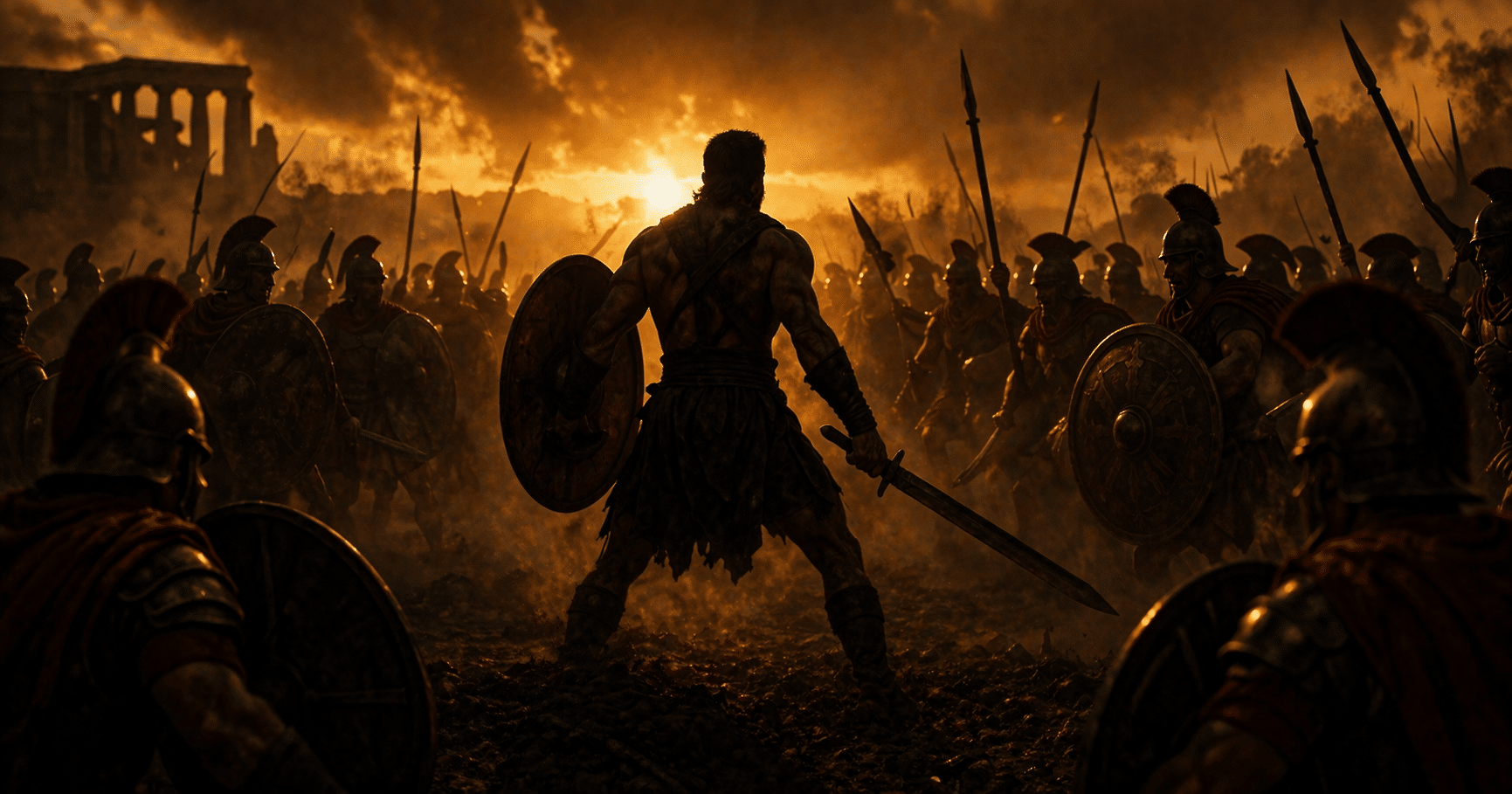
Before he became a legend… before his name echoed through centuries… before Hollywood turned him into myth—there was a real man of flesh, blood, rage, and iron will.
His name was Spartacus.
And Rome feared him.
He was believed to be from Thrace, a rugged land northeast of Greece, a place of mountains, tribes, and hard people. Men from there were known for toughness, battle skill, and survival. Spartacus likely served as a soldier at some point, perhaps even alongside Roman forces before fate turned violently against him.
Then came the fall.
Captured.
Enslaved.
Reduced from man to property.
Imagine that.
One day you carry a weapon as a free man. The next, chains bite your wrists while strangers decide if you eat, live, or die.
That was the Roman world.
And Rome had no mercy for the defeated.
Spartacus was sold into a gladiator school in Capua.
This is where many stories would end.
Because gladiator schools were not noble academies. They were factories of blood. Men trained to kill for entertainment. Beaten, conditioned, starved, armed, and taught that their pain would one day amuse wealthy crowds.
Think of the humiliation.
A warrior turned spectacle.
A human life turned ticket sales.
Rome called it sport.
Every day was discipline, violence, and the smell of fear.
Steel striking steel. Men screaming in training yards. Whips cracking. Sweat and blood soaking sand. Some gladiators were criminals. Some prisoners of war. Some debt-ridden men with no options left.
But many were simply the unlucky.
Spartacus was one of the dangerous ones.
Because some men can be chained…
without being conquered.
In 73 BC, something happened Rome never expected.
Spartacus and around seventy others escaped.
Not with grand weapons at first—but with kitchen knives, stolen tools, and desperation sharpened into courage. They fought guards, seized real weapons, and fled to Mount Vesuvius.
That mountain would become the beginning of humiliation for Rome.
Authorities likely saw them as escaped property.
A nuisance.
A group of runaway slaves that would soon be crushed.
Rome underestimated the one mistake powerful people make too often:
They mistake oppressed people for weak people.
Men began joining Spartacus.
Slaves from farms. Laborers from estates. Gladiators hungry for vengeance. Those who had been beaten, sold, used, forgotten. His force swelled from dozens to thousands.
Why?
Because freedom speaks loudly to the chained.
Spartacus did more than survive.
He led.
And leadership under those conditions is rare.
He organized fighters. Defeated Roman detachments sent against him. Used terrain, mobility, surprise. His men climbed cliffs with vines to outflank Roman forces trapped in arrogance below. Imagine the shame of trained Roman soldiers being outmaneuvered by men they considered beneath them.
Rome laughed first.
Then Rome worried.
Then Rome panicked.
The rebellion grew into a real war.
Villages shook. Estates were abandoned. Wealthy Romans feared what would happen if the lowest people in society discovered their own strength.
Because the fear of empires is not always foreign armies.
Sometimes it is awakened slaves.
Accounts differ on Spartacus’ final intentions.
Some say he wanted to lead people over the Alps so they could return home. Others say divisions within the rebel army complicated everything. Success often brings internal fractures. Even noble causes can be weakened by ego, disagreement, impatience.
That part never changes with time.
Rome eventually responded with seriousness.
Marcus Licinius Crassus, one of the richest men in Rome, took command. He imposed brutal discipline on Roman troops and pursued Spartacus relentlessly.
This was no longer a nuisance.
This was war.
The final campaign was savage.
Spartacus reportedly tried to reach Sicily, perhaps to expand the rebellion, but was betrayed by pirates who took payment and abandoned him. Even then, treachery circled his life.
Eventually, trapped in southern Italy, battle became unavoidable.
Before the last clash, ancient sources say Spartacus killed his own horse.
Why?
Because he told his men if they won, he would have many horses.
If they lost…
he would need none.
That is the language of a man already resolved.
Then came the final battle.
Dust.
Steel.
Screams.
Roman discipline against desperate fury.
Spartacus is said to have fought toward Crassus himself, cutting through soldiers in an attempt to reach the commander. Wounded, surrounded, still pressing forward.
No surrender.
No begging.
No retreat.
The body of Spartacus was never conclusively found.
A fitting ending for a man larger than death.
Rome crushed the rebellion.
And to make a statement, thousands of captured followers were crucified along the Appian Way—mile after mile of bodies lining the road to remind the world what happens when chains are challenged.
That is how power often answers fear.
With spectacle.
But Rome failed in one way.
They killed men.
They could not kill the idea.
Because more than two thousand years later…
people still speak the name Spartacus.
Not the names of the guards who beat him.
Not the names of the men who bought and sold him.
His name.
After the Story — Restored Life After
Most people today do not wear iron chains.
But many wear invisible ones.
Chains of fear.
Chains of addiction.
Chains of shame.
Chains of trauma.
Chains of believing they are less than what God created them to be.
Spartacus reminds us of something powerful:
Just because something binds you…
does not mean it owns you.
You may have been mistreated.
Used.
Undervalued.
Looked down on.
Counted out.
That may explain wounds.
It does not define destiny.
There comes a moment in life when a person must decide:
Will I live as property of my past…
or fight for freedom?
Maybe your mountain is not Vesuvius.
Maybe it is sobriety.
Healing.
Forgiveness.
Truth.
Faith.
Breaking family cycles.
Walking away from what enslaved you.
Bring those chains to God.
Because Rome was powerful.
But not all-powerful.
And whatever holds you today…
is not stronger than the One who made you.
Spartacus fought an empire.
You may only need to fight the lie that says you can never change.
Fight it.
Stand up.
Move.
Lead yourself into freedom.
Because sometimes the world calls you defeated…
right before you rise.
That is Restored Life After.