
Long before churches filled cities, before Christianity spread across the Roman Empire, before the Apostle Paul wrote letters that would shape the faith of millions, there was a man named Stephen.
Most people know how his story ends.
Very few know how he lived.
Stephen appears in the Book of Acts during a time of explosive growth in the early church. Jesus had risen from the dead, ascended into Heaven, and His followers were spreading the gospel throughout Jerusalem. Thousands were becoming believers. What began as a small group of frightened disciples had become a movement powerful enough to shake an empire.
But rapid growth brought challenges.
Widows were being overlooked in the daily distribution of food. The apostles found themselves overwhelmed by the practical needs of the growing church. They needed men of character. Men who could be trusted. Men full of wisdom and faith.
Stephen was one of those men.
The apostles selected seven men to help serve the church, and Stephen’s name appears first on the list. That detail is significant. Scripture describes him as “a man full of faith and of the Holy Spirit.” Those are not words used casually.
Stephen was not chosen because he was famous.
He was chosen because he was faithful.
He was not one of the twelve apostles. He had never walked the dusty roads of Galilee with Jesus. Yet God was using him in extraordinary ways. Acts tells us that Stephen was full of God’s grace and power and performed great wonders and signs among the people.
His faith was not hidden.
It was visible.
His courage was not theoretical.
It was tested.
And soon it would cost him everything.
As Stephen preached about Jesus, opposition began to rise. Religious leaders who had rejected Christ could not ignore what was happening. The message was spreading. Lives were changing. The authority they had spent their lives protecting was being challenged by a gospel they refused to accept.
They argued with Stephen.
They debated him.
They attempted to discredit him.
And they failed.
Scripture says they could not stand against the wisdom and Spirit by which he spoke.
Unable to defeat him honestly, they turned to lies.
False witnesses were recruited.
Accusations were manufactured.
The same tactics that had been used against Jesus were now being used against one of His followers.
Stephen was arrested and dragged before the Sanhedrin, the highest religious court in Israel.
The room would have been intimidating beyond imagination.
The most powerful religious leaders in the nation sat before him.
Men who held influence.
Men who had the power to destroy lives.
Men who had helped condemn Jesus only a short time earlier.
Most people would have softened their words.
Most people would have searched for a way out.
Stephen did neither.
Standing before the very men who wanted him silenced, he delivered one of the most powerful sermons recorded in Scripture.
He began with Abraham.
He walked through the history of Israel.
He spoke of Joseph, Moses, the prophets, and God’s faithfulness throughout generations. But Stephen’s purpose was not simply to teach history.
He was building a case.
A devastating one.
Again and again he showed how God’s people had rejected the very messengers God sent to save them.
Joseph was rejected by his brothers.
Moses was rejected by his people.
The prophets were persecuted.
And finally, when God sent His Son, they rejected Him too.
The tension in the room must have been unbearable.
Then Stephen delivered the words that ignited the fury of the council.
“You stiff-necked people. Your hearts and ears are still uncircumcised. You are just like your ancestors: You always resist the Holy Spirit.”
It was not political.
It was not diplomatic.
It was truth.
And truth often makes enemies before it makes converts.
The men listening to him were enraged.
Their pride was exposed.
Their hypocrisy was uncovered.
Their hatred boiled over.
Then something extraordinary happened.
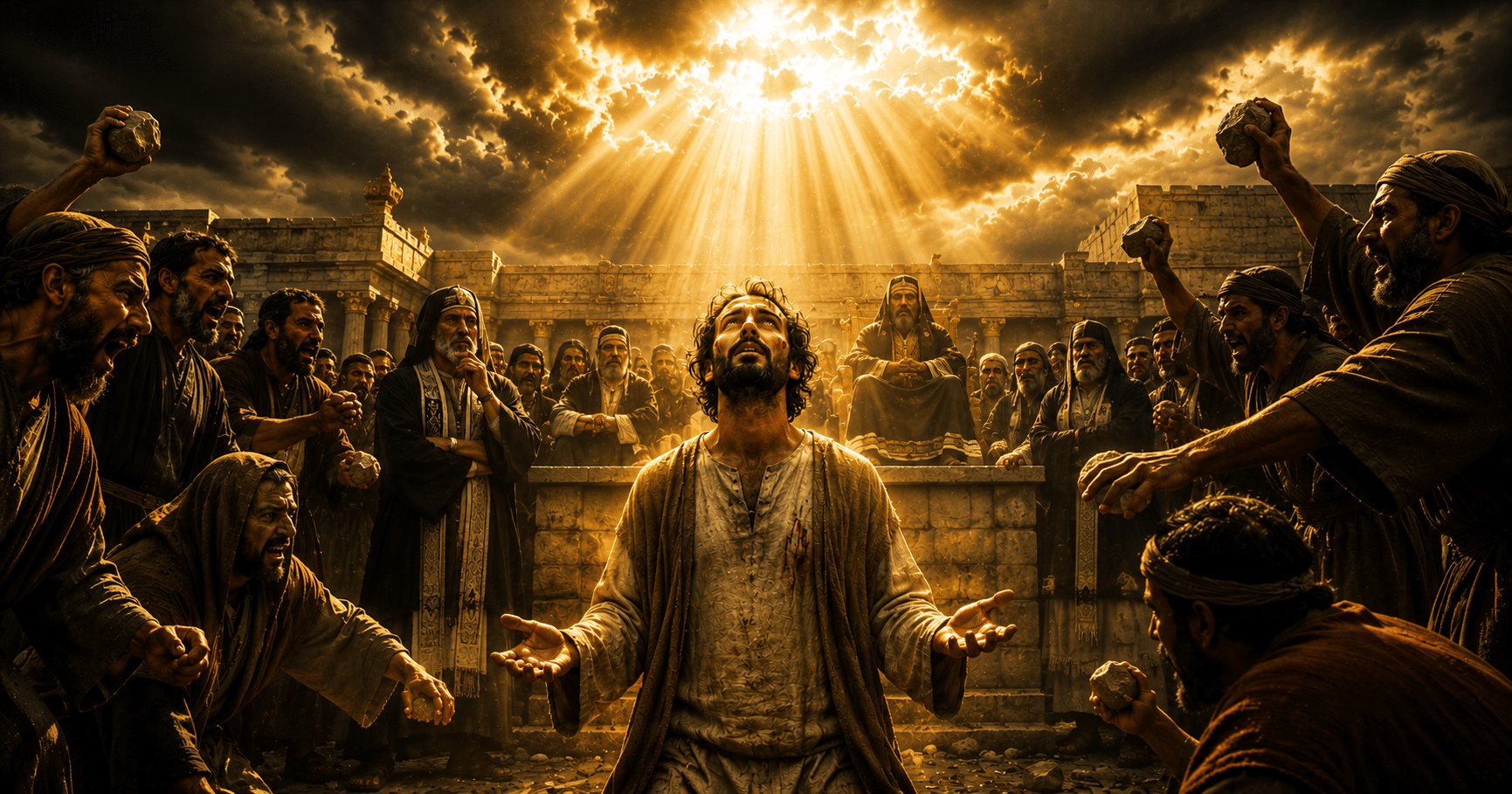
As the fury of the crowd intensified, Stephen looked upward.
Scripture says he was full of the Holy Spirit.
And then he saw something no other martyr recorded in Scripture ever saw.
The heavens opened.
The glory of God appeared before him.
And there stood Jesus Christ at the right hand of God.
Not seated.
Standing.
As if Heaven itself had risen to receive a faithful servant coming home.
Imagine the scene.
The crowd screaming.
Accusations flying.
Hatred surrounding him from every side.
Yet Stephen’s eyes were fixed somewhere else.
The world around him was disappearing.
Eternity was coming into focus.
“Look,” he cried out, “I see heaven open and the Son of Man standing at the right hand of God.”
Those words pushed the crowd beyond rage.
The council covered their ears.
They shouted.
They rushed him as one man.
They dragged him outside the city.
And then the stones began to fly.
There was no quick execution.
No mercy.
No dignity.
Stoning was brutal.
Each rock shattered bone.
Each impact tore flesh.
Each strike pushed him closer to death.
The mob was determined to erase him.
But even as the stones fell, Stephen did something almost impossible to comprehend.
He prayed.
Not for vengeance.
Not for rescue.
Not for his enemies to be destroyed.
He prayed exactly as his Savior had prayed from the cross.
“Lord Jesus, receive my spirit.”
Then came his final words.
Words that have echoed through history for nearly two thousand years.
“Lord, do not hold this sin against them.”
And with that, Stephen died.
The first Christian martyr.
A man whose faith never broke.
A man whose courage never wavered.
A man who saw Heaven before he saw death.
But the story does not end there.
Standing nearby was a young Pharisee named Saul.
Scripture tells us the men who executed Stephen laid their cloaks at Saul’s feet. He was not merely present.
He approved.
He agreed.
He supported what was happening.
As Stephen’s body was crushed beneath the stones, Saul watched.
The screams.
The blood.
The prayer.
The forgiveness.
He saw it all.
At the time, Saul believed he was serving God.
He viewed Christians as enemies.
A dangerous movement that needed to be destroyed.
After Stephen’s death, Saul intensified his persecution of the church. He entered homes, dragged men and women away, and helped scatter believers throughout the region.
Yet something had been planted that day.
A seed.
A memory.
A witness.
Because not long afterward, while traveling to Damascus to arrest more Christians, Saul encountered the risen Christ.
A light brighter than the sun knocked him to the ground.
A voice thundered from Heaven.
“Saul, Saul, why are you persecuting Me?”
In that moment, the persecutor became the pursued.
The hunter became the hunted.
The man who approved of Stephen’s death would become one of Christianity’s greatest defenders.
Saul became Paul.
The missionary.
The church planter.
The writer of much of the New Testament.
The man who would endure beatings, imprisonment, shipwrecks, and eventually martyrdom for the same gospel he once tried to destroy.
And perhaps somewhere in the depths of his memory remained the image of Stephen.
The man who refused to deny Christ.
The man who forgave his killers.
The man who saw Heaven open.
Stephen’s life reminds us that faith is not proven when everything is easy.
Faith is proven when everything is taken away.
His story reminds us that courage is not the absence of fear but the decision to stand anyway.
And his death reminds us that God can use even the darkest moment to accomplish something greater than we can see.
Because on the day Stephen died, a young man named Saul watched.
And through God’s power, the witness of one faithful servant helped change the course of history.
Stephen lost his life.
But through his faithfulness, generations would find theirs.
1 thought on “Stephen: The Man Who Saw Heaven Open”
🕊