
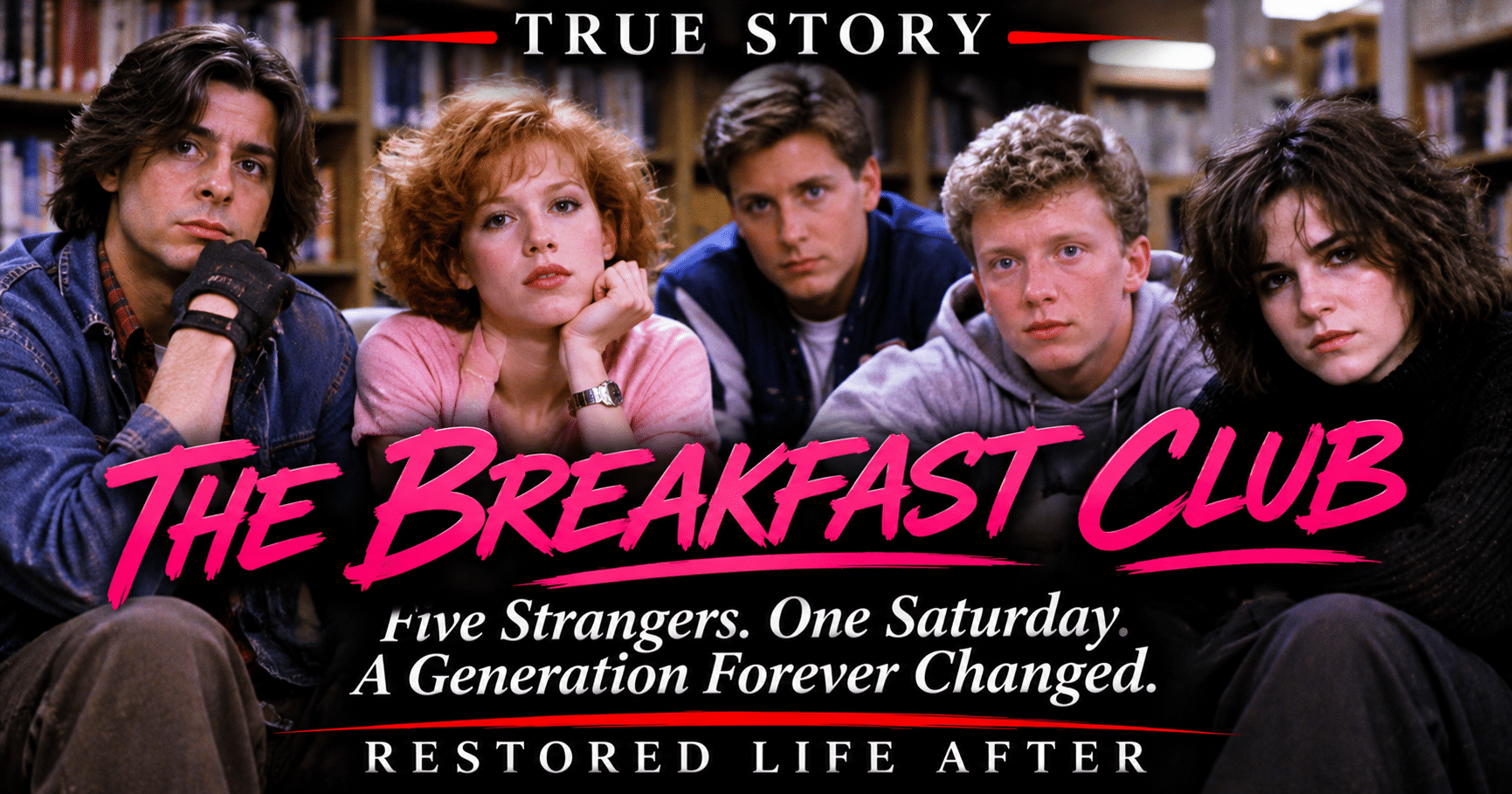
Five teenagers walked into a high school library on a Saturday morning in 1984.
They came from different worlds.
One was popular. One was an athlete. One was brilliant. One was rebellious. And one was the girl nobody seemed to understand.
They had been labeled, judged, and placed into categories by a world that believed it already knew who they were.
But over the course of nine hours, something extraordinary happened.
The walls began to fall.
The secrets came out.
And beneath their carefully constructed identities were five young people carrying pain, fear, insecurity, and the desperate desire to be accepted.
When The Breakfast Club arrived in theaters on February 15, 1985, it did more than entertain audiences.
It gave a generation permission to admit something they had spent years hiding.
Behind every label is a human being. And behind every human being is a story you may know nothing about.
This is the true story of how John Hughes created The Breakfast Club, the young actors who brought it to life, and why a movie made more than forty years ago still speaks to people today.
The Man Behind the Movie — John Hughes
In the early 1980s, Hollywood was filled with teenage movies that often focused on wild parties, sex, rebellion, and outrageous comedy.
But writer John Hughes believed there was another story worth telling.
He remembered what it felt like to be young.
To feel misunderstood.
To be judged before anyone bothered to know you.
To have adults dismiss your problems simply because you were a teenager.
Hughes believed those emotions deserved to be taken seriously.
In July 1982, he wrote the original screenplay for The Breakfast Club in just two days, according to his later recollection.
The concept was remarkably simple.
Five teenagers.
One school library.
One Saturday detention.
Almost no action outside the room.
But Hughes understood something important.
Sometimes the most powerful stories don’t need explosions, elaborate scenery, or extraordinary events. Sometimes all they need is the truth about being human.
The project was initially intended to be his directorial debut, but Hollywood executives were uncertain about entrusting a largely dialogue-driven film to an inexperienced director.
Hughes made Sixteen Candles first.
Its success helped open the door for the movie he had wanted to make all along.
The Creation — An Empty High School and a Million-Dollar Gamble
Production began in March 1984 at the abandoned Maine North High School in Des Plaines, Illinois.
The building had closed several years earlier.
Inside its gymnasium, filmmakers constructed the large, two-story library that would become one of the most recognizable settings in movie history.
The budget was approximately $1 million.
By Hollywood standards, it was a modest production.
There were no expensive special effects.
No elaborate action sequences.
No exotic locations.
Just a handful of actors, a school library, and a script built around human emotions.
Hughes wanted the young performers to understand their characters rather than simply memorize dialogue.
The cast rehearsed extensively, examined their characters’ backgrounds, and discussed the emotional motivations behind their behavior.
Much of the movie was filmed in story order, allowing the actors to experience the gradual changes in their relationships.
What began as a low-budget experiment would become one of the most influential teenage films ever made.
Five Characters — Five Different Kinds of Pain
Hughes assembled five young actors who would become closely associated with 1980s cinema.
Molly Ringwald played Claire Standish — the Princess.
Beautiful, popular, and seemingly privileged, Claire represented the social pressure of maintaining an image.
She appeared to have everything.
But beneath the surface was a young woman afraid of losing her place in the social hierarchy.
Emilio Estevez played Andrew Clark — the Athlete.
Andrew was successful, respected, and expected to live up to his father’s demands.
His story revealed the pressure placed on young people to achieve, compete, and prove their worth.
Anthony Michael Hall played Brian Johnson — the Brain.
Brian was intelligent, academically driven, and desperate to succeed.
But behind his achievements was a young man terrified of disappointing the people around him.
His confession about contemplating suicide after an academic failure became one of the film’s darkest moments.
Ally Sheedy played Allison Reynolds — the Basket Case.
Allison was withdrawn, unpredictable, and socially isolated.
She seemed strange to the others because they did not understand her.
But beneath her behavior was a painful desire to be noticed and accepted.
Judd Nelson played John Bender — the Criminal.
Bender was angry, confrontational, sarcastic, and openly disrespectful toward authority.
He appeared fearless.
But as the story unfolded, viewers learned about the abuse and hostility he experienced at home.
His anger was not an excuse for hurting others, but it revealed that his behavior had a history.
Five teenagers.
Five different lives.
Five labels.
And five people who were far more complicated than the world believed.
The Scene That Revealed the Truth
One of the film’s most memorable sequences occurs when the teenagers sit together and begin revealing their personal struggles.
The conversation moves beyond jokes and insults.
They discuss their parents.
Their fears.
Their reputations.
Their relationships.
And the pressure of becoming what other people expect.
For the first time, they begin seeing one another as individuals rather than stereotypes.
The athlete discovers that the rebel has suffered.
The popular girl recognizes the loneliness of the outsider.
The intelligent student reveals the frightening emotional pressure beneath his academic success.
The characters discover that their experiences are different, but their need for acceptance is remarkably similar.
The movie’s greatest revelation was not that these teenagers were all the same. It was that their differences did not erase their humanity.
That message struck a powerful chord with audiences.
The Famous Ending — A Raised Fist Against the World
Near the end of the film, the students leave detention knowing that Monday morning may return them to their separate social worlds.
Their shared experience has changed how they see one another.
But whether those changes will survive the pressures of school remains uncertain.
As John Bender walks across the football field, he raises his fist into the air.
The song Don’t You (Forget About Me) by Simple Minds plays.
That image became one of the defining moments of 1980s cinema.
The raised fist represented rebellion, triumph, and the feeling of being understood, even if only for one day.
But there was something bittersweet beneath the celebration.
The characters had discovered genuine human connections.
Now they had to return to a world that might punish them for those connections.
Sometimes the hardest part of discovering who you really are is finding the courage to remain that person when everyone else expects you to change back.
February 15, 1985 — The Movie Reaches America
When The Breakfast Club opened in theaters on February 15, 1985, its premise seemed almost too simple.
Five teenagers talking in a library for most of a movie.
But audiences responded.
The film earned tens of millions of dollars, vastly exceeding its modest production budget.
More importantly, it became a cultural phenomenon.
Teenagers recognized themselves in the characters.
Some identified with Brian’s fear of failure.
Others understood Claire’s social pressures.
Some recognized Andrew’s struggle to satisfy his parents.
Others felt Allison’s loneliness or Bender’s anger.
The film gave a voice to young people who often believed nobody was listening.
For many teenagers, The Breakfast Club was not simply entertainment. It was the first time they felt that a movie understood them.
The Generation It Changed
The movie arrived during a decade when social identity was a powerful part of teenage life.
Athletes sat with athletes.
Popular students stayed within their circles.
Outsiders were often ignored.
Students were judged by their clothes, appearance, grades, friends, and family backgrounds.
Hughes challenged those divisions.
He showed that popularity did not eliminate insecurity.
Intelligence did not eliminate emotional pain.
Rebellion did not always mean confidence.
And being quiet did not mean having nothing important to say.
The movie encouraged viewers to question the labels they placed on others.
It also helped change the way Hollywood portrayed teenagers.
Young people were no longer simply comic relief or background characters.
Their emotions, relationships, and internal conflicts could carry an entire film.
The influence of The Breakfast Club can be seen in decades of coming-of-age movies and television programs that followed.
Its impact also extended into music, fashion, and popular culture.
The soundtrack became closely associated with the era, while the film’s famous promotional photograph helped establish an enduring visual image of teenage identity.
John Hughes did not invent teenage insecurity. He simply gave it a face, a voice, and a story the world could no longer ignore.
The Darker Truth — Not Everything About the Movie Has Aged Well
More than forty years after its release, The Breakfast Club continues to inspire discussion.
But its legacy is not without criticism.
Some of its humor, sexual behavior, and treatment of female characters have been questioned by modern audiences.
Molly Ringwald herself has reflected critically on certain scenes, particularly the behavior of John Bender toward Claire.
Allison’s transformation near the end of the film has also raised questions about whether the story unintentionally suggests that a girl must change her appearance to become desirable.
These criticisms are worth considering.
A movie can be influential without being flawless.
And audiences can appreciate its message while recognizing its shortcomings.
Understanding the past does not require pretending that everything about it was right.
Perhaps that is another reason the movie remains important.
It continues to encourage conversations about identity, respect, acceptance, and the way people treat one another.
The Legacy — Why We Still Remember
In 2016, The Breakfast Club was selected for preservation in the United States National Film Registry because of its cultural, historical, and aesthetic significance.
By its fortieth anniversary in 2025, the film had become more than a nostalgic reminder of the 1980s.
It remained a story about problems that never truly disappeared.
Bullying.
Peer pressure.
Loneliness.
Family expectations.
The fear of rejection.
The need to be loved.
Technology has changed.
Music has changed.
Fashion has changed.
Schools have changed.
But human insecurity remains remarkably familiar.
Young people still struggle to fit in.
Adults still judge one another by appearances.
People still hide their pain behind carefully constructed identities.
And countless individuals still feel alone in crowded rooms.
The reason The Breakfast Club continues to matter is that the world has changed far more than the human heart has.
Final Thought — Never Judge a Life by Its Label
Five teenagers entered a library believing they knew exactly who the others were.
A criminal.
A princess.
An athlete.
A brain.
A basket case.
By the end of the day, those labels had lost much of their meaning.
Because beneath the appearances were human beings.
Hurting.
Searching.
Afraid.
And desperate to be understood.
There is a lesson here that reaches far beyond a movie theater.
You never truly know what another person is carrying.
The successful businessman may be fighting loneliness.
The beautiful woman may be struggling with insecurity.
The rebellious teenager may be suffering behind closed doors.
The quiet person you overlook may be carrying more pain than you could imagine.
And the person you judge most harshly may be the person who needs compassion most.
In 1 Samuel 16:7, Scripture reminds us:
“For man looketh on the outward appearance, but the LORD looketh on the heart.”
God sees what people often overlook.
He sees beyond appearances, reputations, possessions, and social standing.
Perhaps we should learn to look a little deeper ourselves.
John Hughes created a movie about five teenagers who discovered that their differences did not make them enemies.
Their shared humanity gave them a reason to understand one another.
And that lesson is just as important today as it was in 1985.
Don’t become so consumed with the labels people wear that you forget the hearts beating beneath them.
Because one day, the popularity will fade.
The school years will become distant memories.
The achievements and disappointments will pass.
But the way we treated people will remain part of our story.
The Breakfast Club taught a generation that everyone has a story. God reminds us that every soul has value.
RESTORED LIFE AFTER