
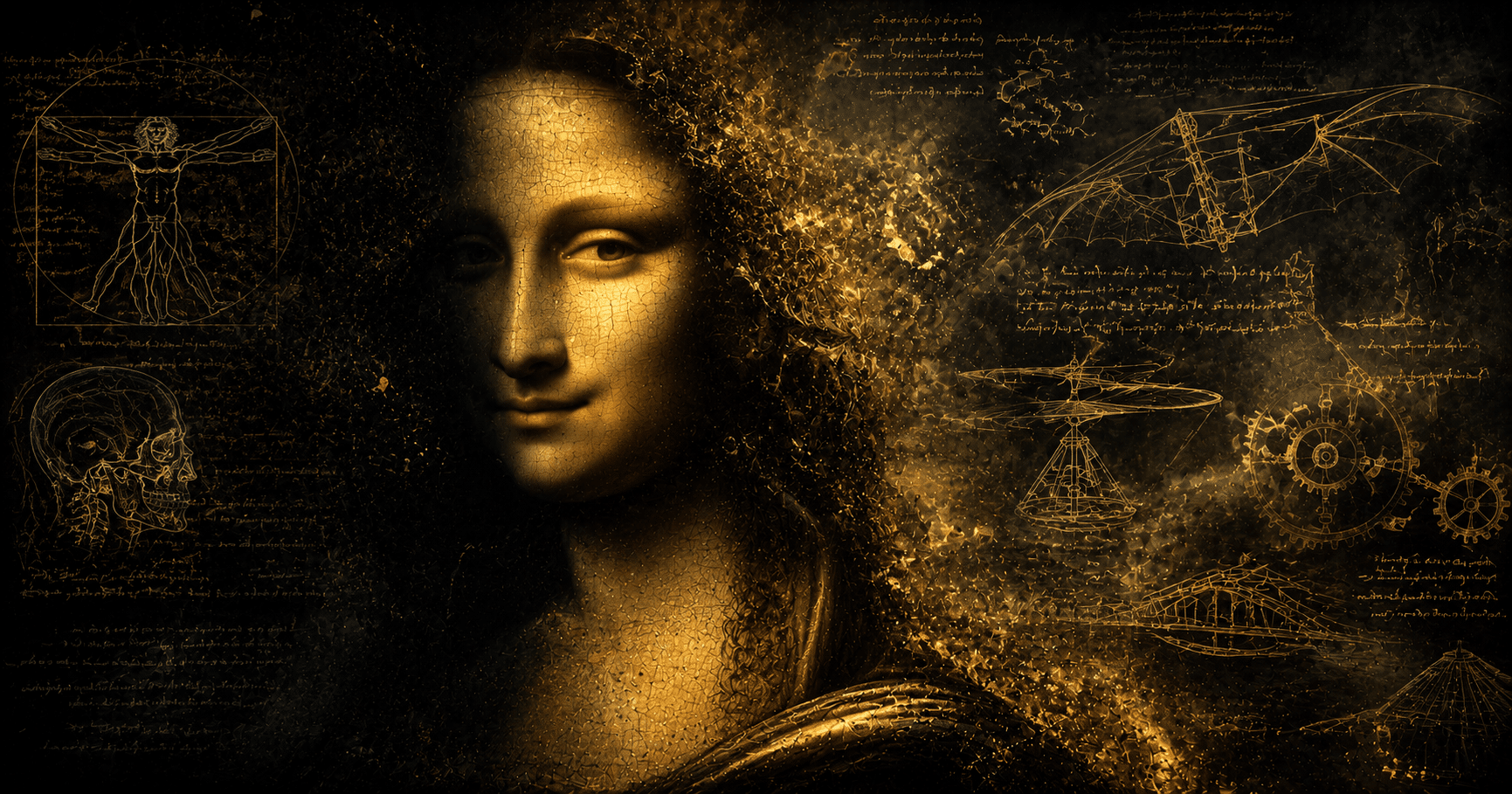
The Extraordinary Life of Leonardo da Vinci
Five hundred years after his death, the world still struggles to understand Leonardo da Vinci.
Some remember him as a painter.
Others remember him as an inventor.
Some know him as the creator of the Mona Lisa or The Last Supper.
But the truth is far more astonishing.
Leonardo da Vinci may have been the most gifted human being who ever lived.
He was a man born centuries before the world was ready for him. A man whose notebooks contained ideas that would not become reality for another four hundred years. A man who painted masterpieces that still captivate millions while simultaneously designing flying machines, armored vehicles, bridges, weapons, diving equipment, and anatomical studies so accurate they continue to amaze scientists today.
Yet beneath the genius was a lonely and complicated soul. A restless mind trapped inside a world too small for his imagination.
Leonardo was born in 1452 in the small Italian village of Vinci. He was born out of wedlock, the illegitimate son of a notary and a peasant woman. In Renaissance Italy, this mattered. Society placed enormous value on family lineage and legitimacy. From the moment he entered the world, Leonardo existed on the edge of two worlds—accepted by neither completely.
Perhaps that outsider status shaped him.
Because while other children followed traditional paths, Leonardo wandered fields, studied birds, collected insects, sketched plants, and stared endlessly at rivers, clouds, and mountains. He became obsessed with understanding how everything worked. Why birds flew. Why water moved. Why muscles flexed. Why shadows formed. Why humans laughed, cried, aged, and died.
Most people accept the world.
Leonardo questioned it.
Every part of it.
At fourteen, he was apprenticed to the renowned Florentine artist Andrea del Verrocchio. The workshop was one of the finest in Italy and became the perfect training ground for the young prodigy. There he learned painting, sculpture, engineering, architecture, metallurgy, and design.
The legends say that during one painting, Leonardo was assigned to paint an angel while Verrocchio completed the rest of the work. The angel was so beautifully executed that the master reportedly vowed never to paint again.
Whether entirely true or not, the story captures something important.
Leonardo’s talent was impossible to ignore.
But talent alone does not explain him.
Thousands of gifted artists have existed throughout history.
There was only one Leonardo.
What made him extraordinary was his curiosity.
His notebooks reveal a mind that never rested. Thousands of pages survive today, filled with observations, sketches, diagrams, scientific theories, mathematical calculations, anatomical studies, inventions, and philosophical reflections. Some pages contain dozens of questions written in rapid succession.
How do birds remain aloft?
Why is the sky blue?
How does memory work?
What causes laughter?
How does the human heart function?
Imagine a mind that never stops asking questions.
Imagine carrying that mind every waking moment of your life.
For Leonardo, the world itself was a puzzle begging to be solved.
Among all his accomplishments, however, two paintings would secure his immortality.
The first was The Last Supper.
Painted between 1495 and 1498 in a monastery dining hall in Milan, it became one of the most influential artworks in history. Rather than depicting a calm religious gathering, Leonardo captured a single explosive moment—the instant Jesus announces that one of His disciples will betray Him.
The reactions are extraordinary.
Shock.
Disbelief.
Fear.
Anger.
Confusion.
Every apostle responds differently. Some lean forward. Others recoil. Some whisper to one another. One reaches for a knife. Another clutches his chest.
At the center of the chaos sits Christ.
Calm.
Still.
Unshaken.
The contrast is breathtaking.
Even today, viewers can feel the tension frozen within that moment.
Yet few people realize how revolutionary the painting truly was. Before Leonardo, religious figures often appeared stiff and symbolic. Leonardo painted them as human beings. Real people experiencing real emotions. The result transformed Western art forever.
Sadly, the masterpiece began deteriorating almost immediately because Leonardo experimented with an untested technique instead of traditional fresco painting. Within decades portions were already fading. Centuries of damage followed. Wars, neglect, moisture, and restoration attempts nearly destroyed it.
And yet it survives.
Broken.
Scarred.
Incomplete.
Still captivating millions.
Perhaps much like Leonardo himself.
Then came the painting that would become the most famous face in human history.
The Mona Lisa.
No artwork on earth has generated more fascination.
Millions travel across continents merely to stand before it for a few seconds.
At first glance, it seems surprisingly simple.
A woman.
A chair.
A landscape.
A faint smile.
Nothing dramatic.
No battles.
No miracles.
No grand events.
Yet the painting possesses a strange power.
The smile appears to change depending upon where you look.
Sometimes warm.
Sometimes distant.
Sometimes joyful.
Sometimes sad.
The eyes seem alive.
The face appears almost capable of movement.
The mystery has endured for over five centuries.
Who was she?
Why is she smiling?
What was Leonardo trying to communicate?
Modern scholars believe the subject was likely Lisa Gherardini, wife of a Florentine merchant. Yet Leonardo carried the painting with him for years, continually refining it long after the commission should have been completed.
Why?
Perhaps because he viewed it as more than a portrait.
Perhaps he saw something deeper.
A meditation on humanity itself.
Life.
Beauty.
Mystery.
The fleeting nature of existence.
The smile of someone who understands something the viewer never fully will.
Like much of Leonardo’s work, the painting refuses to reveal all its secrets.
That may be why it remains unforgettable.
But for all his brilliance, Leonardo was far from perfect.
He struggled constantly with unfinished projects. He became distracted by new ideas before completing old ones. Patrons often grew frustrated waiting for commissions. Some major works were abandoned entirely. His notebooks reveal endless beginnings but relatively few conclusions.
His greatest strength was also his greatest weakness.
His curiosity.
There was always another mystery.
Another invention.
Another question.
Another possibility.
The future fascinated him more than the present.
Many inventions hidden inside his notebooks seemed impossible during his lifetime.
Helicopter-like flying machines.
Parachutes.
Armored vehicles.
Machine guns.
Scuba equipment.
Robotic mechanisms.
Advanced engineering systems.
Modern scientists have repeatedly built working models based on his sketches.
Many function remarkably well.
The tragedy is that Renaissance technology lacked the materials and manufacturing capabilities necessary to fully realize his visions.
Leonardo saw centuries ahead.
But he could not travel there himself.
As he aged, he continued filling notebooks with ideas while moving between courts and patrons. Eventually he entered the service of Francis I of France, who admired him deeply and treated him with extraordinary respect.
By then Leonardo’s body was weakening.
His hands had begun failing him.
The artist who spent a lifetime drawing the world could no longer fully command his own fingers.
One final cruel irony.
The mind remained brilliant.
The body could not keep pace.
On May 2, 1519, Leonardo da Vinci died in France at the age of sixty-seven.
The world lost one of its greatest minds.
Yet perhaps the most remarkable thing about Leonardo is not the paintings.
Not the inventions.
Not even the genius.
It is the way he looked at life.
He approached existence with wonder.
Where others saw ordinary things, he saw mysteries.
Where others found answers, he found new questions.
Where others accepted limitations, he imagined possibilities.
Five centuries later, his paintings still draw crowds. His notebooks still inspire scientists. His ideas still influence engineers. His name still symbolizes genius itself.
But perhaps his greatest lesson is simpler.
Never stop being curious.
Never stop learning.
Never stop asking why.
Because the man who painted the world’s most famous smile spent his entire life chasing mysteries he knew he would never fully solve.
And in doing so, he changed the world forever.