
Some people become famous.
Some become legends.
And a very small few become larger than life.
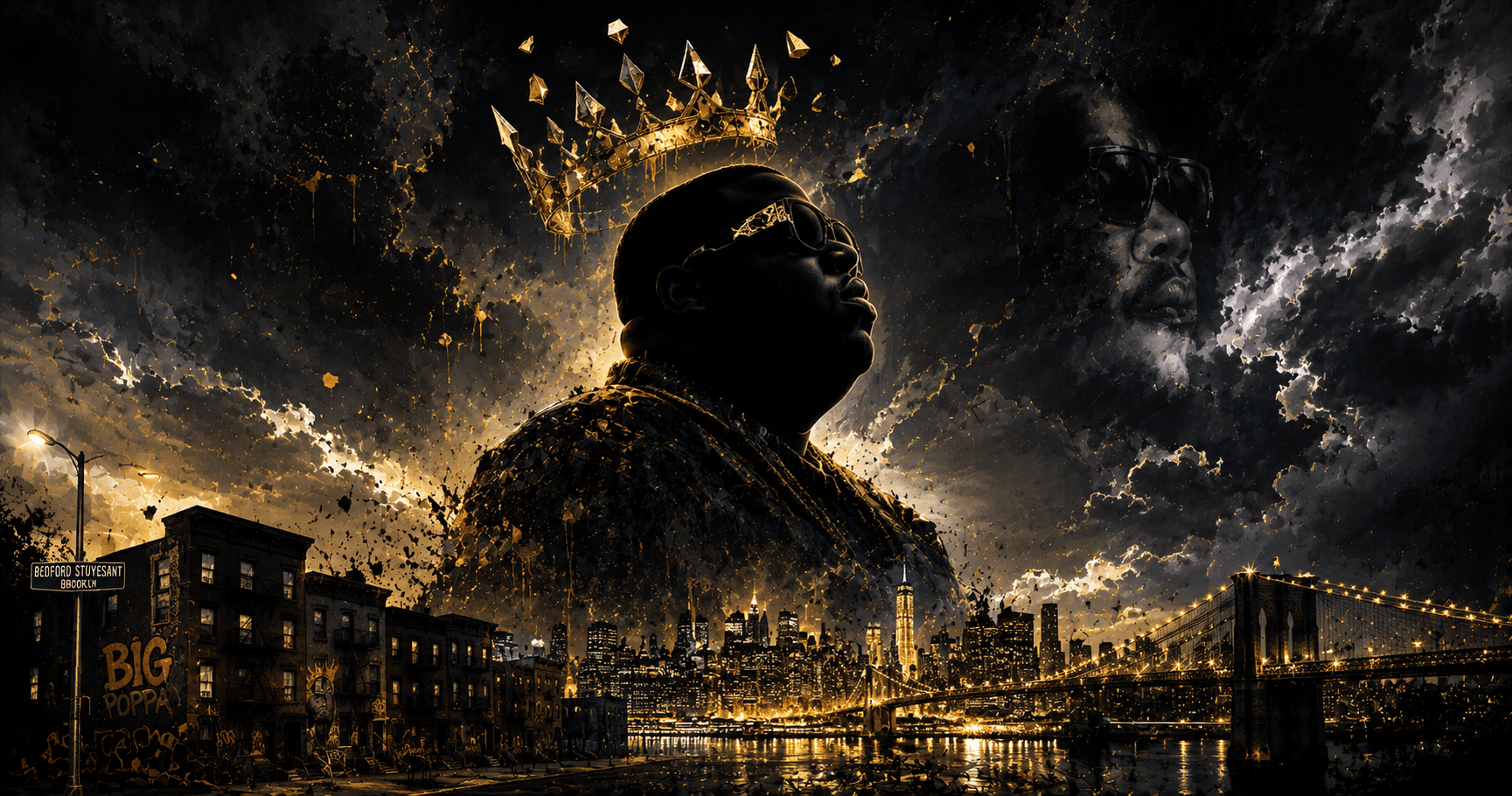
Christopher Wallace, known to the world as The Notorious B.I.G., Biggie Smalls, or simply Biggie, became one of those rare figures whose story transcended music. His life was a tale of talent, hardship, ambition, fame, violence, and tragedy. It was the story of a young man who rose from the tough streets of Brooklyn to become one of the greatest rappers who ever lived, only to have his life cut short before his thirtieth birthday.
Biggie was born Christopher George Latore Wallace on May 21, 1972, in Brooklyn, New York. He was raised in the Bedford-Stuyvesant neighborhood, an area that was tough even by New York standards. Crime, drugs, violence, and poverty were everyday realities. His father left when Christopher was very young, leaving his mother, Voletta Wallace, to raise him alone.
His mother worked long hours and sacrificed everything she could to provide a better life for her son. She believed education would be his path out. She pushed him to stay in school and encouraged him to pursue his potential.
But the streets were always there.
Young Christopher was intelligent, charismatic, and naturally gifted with words. Friends often remarked on his remarkable memory and ability to tell stories. He could make people laugh. He could command attention. Even as a teenager, he possessed the kind of presence that filled a room.
Unfortunately, he was also drawn to the streets.
By his early teens, Biggie was selling drugs. While many young men in his neighborhood saw dealing as a way to survive, Christopher excelled at it. He later admitted that much of his teenage life revolved around hustling and trying to make money.
Yet even during those difficult years, another talent was emerging.
Rap.
Biggie began battling other rappers and performing freestyle rhymes on street corners. People immediately noticed something different about him. His flow was effortless. His storytelling was vivid. He painted pictures with words.
Unlike many rappers who relied purely on aggression, Biggie could make listeners feel like they were standing beside him inside the story.
His talent eventually found its way onto demo tapes that circulated throughout New York.
One of those tapes reached the hands of a young producer named Sean Combs, later known as Puff Daddy.
Everything changed.
Puff immediately recognized what he was hearing.
A superstar.
He signed Biggie to his newly formed record label and began introducing him to the music world.
In 1994, Biggie released his debut album, Ready to Die.
The title itself was dark.
The music was raw.
The stories were brutally honest.
Biggie rapped about poverty, crime, ambition, survival, depression, and the realities of inner-city life.
The album became an instant classic.
Songs like “Juicy” told the story of a young man who transformed his dreams into reality. The track remains one of the most famous underdog stories ever recorded in hip-hop.
One of the most memorable lines from the song became a rallying cry for dreamers everywhere:
“It was all a dream…”
Those words introduced millions of listeners to the life of Christopher Wallace.
Almost overnight, Biggie became one of the biggest names in rap music.
Money arrived.
Fame arrived.
Luxury arrived.
But success did not remove the shadows that had followed him since childhood.
As hip-hop exploded in popularity during the mid-1990s, tensions grew between East Coast and West Coast rap artists. What began as competition gradually evolved into something darker.
At the center of the storm were Biggie and fellow superstar rapper Tupac Shakur.
The two men had once been friends.
They admired each other’s talent.
They shared stages and conversations.
But a series of misunderstandings, accusations, and media-fueled conflicts created one of the most infamous rivalries in music history.
Whether either man truly wanted the conflict to escalate remains a subject of debate.
What is certain is that the rivalry became bigger than either of them.
Fans chose sides.
Record labels benefited.
The media amplified every rumor.
And the atmosphere grew increasingly dangerous.
While all of this unfolded, Biggie continued making music that showcased extraordinary talent. His ability to tell stories was unmatched. He could paint vivid scenes of street life, success, regret, ambition, and struggle.
Even critics who disliked rap often admitted that Biggie possessed a rare gift.
His lyrics were cinematic.
His voice was unmistakable.
His delivery was effortless.
He had become the king of East Coast hip-hop.
Then tragedy struck.
In September 1996, Tupac Shakur was murdered in Las Vegas.
The music world was stunned.
Many hoped the violence would end.
Instead, fear grew.
Six months later, on March 9, 1997, Biggie attended a music industry event in Los Angeles.
He was only 24 years old.
As he left the event and sat inside a vehicle, another car pulled alongside him.
Shots were fired.
Christopher Wallace was hit multiple times.
Within minutes, one of the most gifted artists of his generation was gone.
He was twenty-four years old.
Twenty-four.
Think about that.
At an age when most people are still trying to discover who they are, Biggie had already transformed an entire genre of music.
And then his story ended.
His murder remains officially unsolved to this day.
The tragedy shocked the world.
Fans mourned.
Artists mourned.
Even many rivals mourned.
Because beneath the headlines and controversies was a young man whose life had been shaped by circumstances, choices, dreams, and struggles.
Just weeks after his death, his second album, Life After Death, was released.
The title seemed hauntingly prophetic.
The album became one of the best-selling and most celebrated hip-hop records ever created.
Ironically, Biggie’s fame became even larger after his death than during his life.
Today, nearly three decades later, his influence remains enormous.
Artists still study his lyrics.
Fans still quote his music.
His story continues to fascinate people because it represents both the promise and the tragedy of human potential.
Biggie possessed extraordinary gifts.
He achieved incredible success.
He inspired millions.
Yet his life also serves as a reminder of how quickly fame, conflict, and violence can destroy even the brightest stars.
Christopher Wallace escaped poverty.
He escaped obscurity.
He achieved wealth and fame beyond anything the young boy from Brooklyn could have imagined.
But he could not escape the violence that surrounded his world.
His story is ultimately one of talent and tragedy.
A young man who turned pain into poetry.
A storyteller whose voice still echoes decades later.
A legend whose life ended far too soon.
And a reminder that no amount of money, fame, or success can replace the value of life itself.