
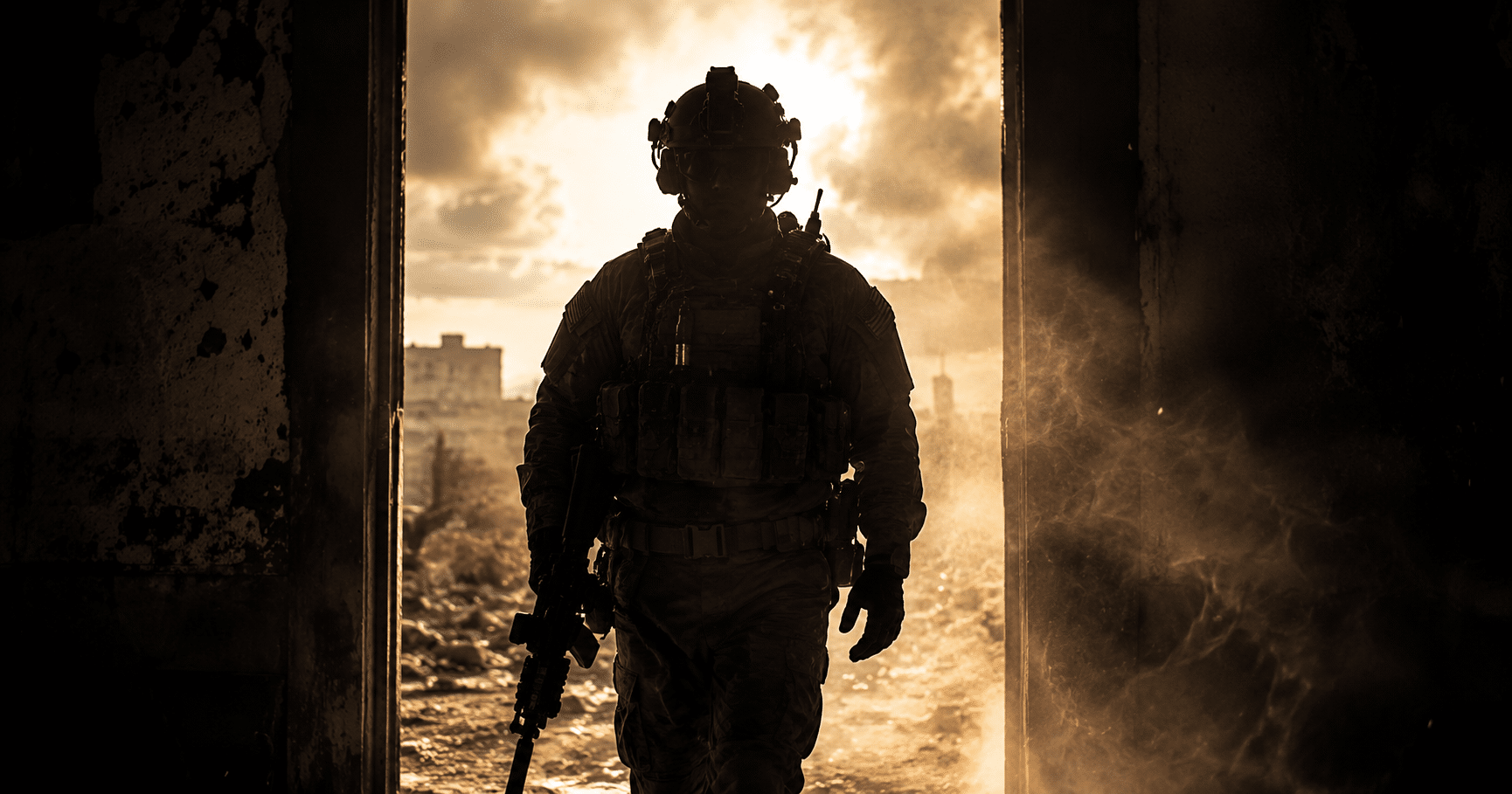
Most people will never know what it feels like to walk willingly into darkness.
Not the darkness of fear.
Not the darkness of uncertainty.
But the darkness where men are hunting other men.
Where every doorway could be your last.
Where every decision carries the weight of life and death.
Tom Satterly spent most of his adult life in that world.
For twenty-five years he served in the United States Army. Twenty of those years were spent in one of the most secretive and elite military units ever created—Delta Force. He would deploy across the globe, fight in some of America’s most dangerous conflicts, help capture Saddam Hussein, rescue hostages, hunt terrorists, and survive battles that would become military legend. Yet his greatest battle would not be fought overseas.
It would be fought inside his own mind.
But before he became a Delta Force operator, before the medals, the deployments, and the war stories, Tom Satterly was just a young man from Indiana searching for purpose.
As a teenager, he wasn’t dreaming about becoming one of the most feared warriors on earth. Like many young men, he simply wanted adventure. The military offered something bigger than the small-town life he knew. It offered challenge. Purpose. Brotherhood. A chance to test himself against the unknown.
He joined the Army and became a combat engineer. His original job was not glamorous. He was trained to build, demolish, clear obstacles, and support combat operations. But something happened during his early years in uniform.
He discovered he wanted more.
While stationed in Germany, he attended elite military schools, including French Commando training and German Ranger training. He began competing against soldiers who were faster, stronger, and more disciplined than average troops. Instead of being intimidated, he became obsessed with improvement. Every challenge only fueled the fire.
Then came Special Forces.
The Green Berets.
For most soldiers, earning the Green Beret would have been the ultimate achievement. These were the Army’s unconventional warriors—men capable of operating behind enemy lines, training foreign fighters, and conducting missions few would ever hear about.
Tom earned his place among them.
Most people would have stopped there.
Tom didn’t.
Because there was another unit.
A unit spoken about in whispers.
A unit that recruited from the very best of the Special Operations community.
A place where even Green Berets, Rangers, and SEALs could fail.
Delta Force.
Officially known as 1st Special Forces Operational Detachment-Delta.
Simply called “The Unit” by those inside it.
To understand Delta Force, you have to understand what separates them from everyone else.
The Army doesn’t simply hand someone a Delta Force patch.
In fact, there isn’t even a public patch.
There is no public graduation ceremony.
No parade.
No spotlight.
The selection process is designed to break a man mentally long before it breaks him physically.
Candidates carry heavy rucksacks through mountains.
Alone.
No cheering crowds.
No teammates encouraging them.
No instructors telling them how close they are.
Just endless miles of pain and uncertainty.
The famous “Long Walk” has ended countless dreams.
Many of the finest soldiers in America have failed there.
Some quit.
Some are removed.
Only a tiny percentage survive.
Tom survived.
Then came the Operator Training Course.
Months of advanced shooting.
Close-quarters battle.
Explosives.
Sniper training.
Hand-to-hand combat.
Advanced driving.
Counter-terrorism.
Hostage rescue.
Intelligence gathering.
Foreign weapons.
Breaching compounds.
Every skill needed to hunt the world’s most dangerous men.
When he finally completed the training pipeline, Tom joined one of the most capable military organizations on earth.
And almost immediately, war found him.
His first major combat experience would become one of the most famous battles in modern military history.
Mogadishu.
Somalia.
October 3, 1993.
The world would later know it as Black Hawk Down.
The mission was expected to last less than an hour.
A quick raid.
Capture key leaders connected to warlord Mohamed Farrah Aidid.
Get in.
Get out.
Simple.
But war has a way of laughing at plans.
When Black Hawk helicopters were shot from the sky, the mission transformed instantly.
Now it wasn’t a raid.
It was a rescue.
What followed was an eighteen-hour nightmare of gunfire, explosions, chaos, and survival. Delta operators, Rangers, and helicopter crews fought block by block through hostile streets packed with armed fighters. American vehicles were ambushed. Soldiers were wounded. Others were killed. The enemy seemed endless.
For Tom Satterly, this was his introduction to real combat.
Not training.
Not rehearsals.
Not simulations.
Life and death.
He later recalled wondering if they would make it out alive.
The confidence built through years of elite training collided headfirst with the brutal reality of war.
Yet that battle revealed something important.
Training works.
When fear takes over, men don’t rise to the occasion.
They fall to their level of preparation.
And Delta Force had prepared relentlessly.
The battle became legendary.
The movie Black Hawk Down would introduce millions to the events of Mogadishu.
But for the men who fought there, it wasn’t entertainment.
It was memory.
It was sacrifice.
It was survival.
And for Tom, it was only the beginning.
Over the next two decades, he would deploy repeatedly into the world’s most dangerous places. Bosnia. Afghanistan. Iraq. Counter-terrorism missions. Direct-action raids. Hostage rescues. High-value target operations. Thousands of missions that will likely never be fully known to the public.
One of the most significant operations associated with his career was Operation Red Dawn—the mission that resulted in the capture of Saddam Hussein. After months of intelligence gathering and relentless pursuit, American special operations forces closed in on one of the most wanted men in the world. Saddam was eventually discovered hiding in a concealed underground space near Tikrit. The operation represented years of sacrifice, intelligence work, and battlefield pressure applied by special operations forces.
By this point, Tom had become one of the most experienced operators in Delta Force.
He wasn’t merely participating in missions anymore.
He was leading them.
Leading men into danger.
Making decisions with consequences measured in lives.
The kind of responsibility few people can imagine carrying.
The military recognized that leadership.
Tom eventually rose to the rank of Command Sergeant Major—the highest enlisted rank in the Army. Along the way he earned dozens of decorations, including multiple Bronze Stars, two awarded for valor in combat.
To outsiders, it looked like the perfect military career.
The missions.
The medals.
The reputation.
The respect.
But there was another story unfolding.
A story no one could see.
Years of combat leave marks.
Not all of them are visible.
The explosions fade.
The deployments end.
The wars eventually become history.
Yet many warriors bring pieces of those battlefields home with them.
Tom later spoke openly about Post-Traumatic Stress, survivor’s guilt, depression, and the invisible wounds carried by so many special operators. The man who had survived firefights, terrorist hunts, and some of the most dangerous missions on earth found himself facing an enemy he could not shoot, outrun, or outfight.
That honesty may be one of his greatest acts of courage.
Because elite warriors are often viewed as invincible.
They aren’t.
They’re human.
They bleed.
They grieve.
They carry scars.
And sometimes the strongest thing a warrior can do is admit he needs help.
Today, Tom and his wife Jen help veterans through the All Secure Foundation, an organization dedicated to helping Special Operations veterans and their families heal from the invisible wounds of war.
Tom Satterly’s story isn’t merely about becoming Delta Force.
It is about discipline.
Sacrifice.
Brotherhood.
Service.
And the reality that even the toughest warriors on earth must eventually face battles no weapon can win.
The world remembers the firefights.
The medals.
The missions.
But perhaps the greatest lesson from Tom Satterly’s life is this:
Strength is not measured by how much darkness you can walk through.
Strength is measured by whether you can find your way back from it.